
A steady hum or growl that gets louder with speed and shifts when you turn usually points to a wheel bearing. A roar that changes with the road surface and eases after a tire rotation points to the tires. Run a quick swerve test on a quiet road first; if the bearing suspicion is strong, stop driving and get it inspected before going further.
TL;DR:
- If the noise shifts with steering load and persists after tire rotation, a wheel bearing is the most likely cause.
- A bearing issue often builds gradually, with symptoms including a rising hum, vibration, and louder noise when turning or braking.
- Tire noise typically varies with surface and temperature, diminishes after rotation, and shows uneven tread wear patterns like cupping.
- Performing the swerve test, jack-and-spin, and tire rotation helps isolate whether the problem is a bearing or a tire, but each test has limitations.
- Driving on a known bad wheel bearing is unsafe and requires immediate professional inspection, especially if wobble or grinding occurs.
Table of Contents
- Wheel bearing vs tire noise: a step-by-step diagnostic workflow
- What a bad wheel bearing typically sounds and behaves like
- What tire noise typically sounds and behaves like
- Confirming it: the swerve test, the jack test, and their limits
- Inspection checklist: tire, wheel, and hub
- Safety, likely costs, and when to take it to a shop
- How Garagemap helps you get from self-diagnosis to a real answer
- A mechanic's honest advice on this diagnosis
- Get a second opinion before you pay for parts
- Sources
Wheel bearing vs tire noise: a step-by-step diagnostic workflow
You don't need a lift or a scan tool to narrow this down. You need a quiet road, a passenger, and about fifteen minutes.
Start with safety. Put a passenger in the back seat so they can listen without the engine and wind noise from the driver's seat masking anything. Pick a stretch of road that's smooth, not busy, and wide enough to swerve gently without startling anyone around you.
- Drive at a steady 50 to 80 km/h on smooth pavement and listen for a hum, growl, or roar. Note if it rises and falls with your speed.
- Swerve gently left, then right, without braking. A bearing hum usually changes when you steer because turning shifts weight onto one side and loads that wheel's bearing harder.
- Brake lightly and corner at low speed in a parking lot. Noise that spikes under braking or cornering often means a bearing; noise that stays flat usually doesn't.
- Back at home, jack up the car safely (proper jack points, wheel chocks, and a jack stand, never just the jack), spin each wheel by hand, and watch the tread while it turns.
- Rotate the tires front to back, or swap side to side if that's not possible, then repeat the road test.
If the noise moved with the tire, you're looking at a tire problem. If it stayed with the same corner of the car and got louder under steering load, the bearing is the more likely culprit.
Pro Tip: Do the swerve test on a road with no traffic behind you, and keep both hands on the wheel. A sudden bearing failure mid-swerve is rare, but you want room to react if something feels off.
What a bad wheel bearing typically sounds and behaves like
A failing bearing rarely announces itself with a single, obvious noise. It tends to build slowly, which is why so many owners drive on one for weeks before booking a repair.
- A steady hum or growl that rises in pitch as your speed increases.
- A rumble that gets noticeably louder when you steer, brake, or corner, because the load shifts onto the worn bearing.
- Vibration through the steering wheel or floor, sometimes paired with a slight pull to one side.
- Symptoms that intensify with slight turning, which is one of the clearest tells versus tire noise.
Here's the part that trips up a lot of DIY checks: some bearings that sound clearly worn will show zero detectable play when you jack the car up and wiggle the wheel by hand. A bearing can be audibly on its way out while still feeling tight to the touch, so a clean jack test doesn't clear it.
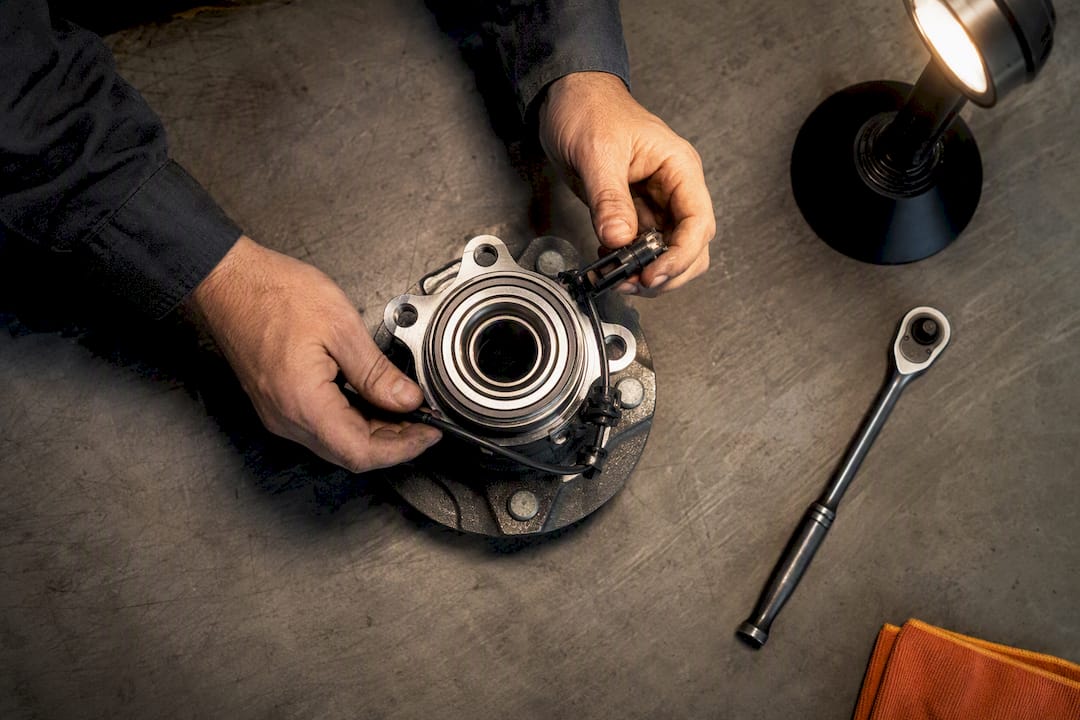
That matters because modern hub assemblies often bundle in the ABS sensor. If yours needs replacing, you're not buying a simple bearing kit. You're buying the whole hub unit, and delaying the repair only risks more damage to the hub and surrounding components.
What tire noise typically sounds and behaves like
Tires cause more noise complaints than most owners expect, and the sound profile is genuinely different once you know what to listen for.
- A roar or rumble that changes noticeably between asphalt, concrete, and gravel, something a bearing almost never does.
- A rhythmic thump or hum tied to the tread pattern, more obvious at highway speed.
- Noise that shifts or disappears entirely after a tire rotation, a strong sign the tire itself is the source.
- Louder or different noise depending on tire temperature, inflation pressure, and how recently the tires were rotated.
Cupping and scalloping, which are wavy, uneven wear patterns caused by worn suspension parts or missed rotations, produce a growl that can sound almost identical to a bearing. Belt separation inside the tire adds a thumping vibration that gets worse with speed. Both of these are exactly why owners walk into a shop convinced they need a hub replacement and walk out with a tire recommendation instead.
Confirming it: the swerve test, the jack test, and their limits
Three tests do most of the diagnostic work, but each one has a blind spot worth knowing before you trust the result.
- Swerve/load test. On an empty road, ease into a gentle side-to-side motion at a steady speed. If the noise gets louder in one direction and quieter in the other, you're loading and unloading a bearing on one side. This is the same technique shops use during a structured road test before ordering parts.
- Jack-and-spin. Raise the wheel, spin it by hand, and feel for roughness or grinding. Useful, but limited: a bearing under vehicle weight and cornering load can be noisy on the road and feel smooth with the tire off the ground. A quiet jack test is not a clean bill of health.
- Tire rotation. Swap the tires and repeat your road test. Noise that fully follows the tire to its new position confirms a tire issue. Noise that partially changes, or stays put on one corner, suggests you may be dealing with both a tire and a bearing problem at once.
Pro Tip: If the noise only shows up while cornering one direction and never the other, book a professional road test before you replace anything. A one-sided pattern like that is one of the more reliable tells a technician looks for.
When none of these tests give you a clean answer, that's your cue to stop guessing and get a hub inspection.
Inspection checklist: tire, wheel, and hub
Before you call a shop, spend five minutes checking what you can see and feel.
- Tires: look for cupping, scalloping, uneven wear across the tread, or bulges and separation along the sidewall.
- Wheel and hub: grip the tire at the 12 and 6 o'clock positions and check for play, but remember that a lack of play doesn't rule out a noisy bearing.
- Other culprits: check for a bent dust shield rubbing the rotor, a dragging brake caliper, or a clicking CV joint, all of which get misread as bearing noise.
- Document everything. Note when the noise happens, which direction of steering makes it louder, and take photos of any wear patterns you find.
Pro Tip: Bring your notes and photos to the shop instead of just describing the sound from memory. It genuinely speeds up diagnosis and helps a technician avoid swapping parts that were never the problem.
Safety, likely costs, and when to take it to a shop
This isn't a wait-and-see situation once the symptoms line up with a bearing. Driving on a failed wheel bearing is unsafe and can eventually lead to wheel separation, so grinding, wobble, or looseness at the wheel needs attention right away, not next month.
Cost is where things get complicated. A bare bearing kit is one price; a full hub assembly with an integrated ABS sensor is another, and ABS-equipped hubs push the parts cost higher than older bearing-only designs. Add labour, and sometimes an alignment if the hub geometry gets disturbed during the job.
- A proper shop visit should include a road test, not just a visual check.
- Expect the technician to inspect the hub directly and check ABS sensor function if the vehicle has one.
- Ask for a clear diagnosis before parts get ordered. Bring your test notes: when the noise happens, what direction amplifies it, any photos of tread wear.
- A shop that skips straight to "you need a new hub" without driving the car first is worth a second opinion.
Catching a bearing issue early also protects your tires. An advanced bearing failure can wear a tire unevenly, turning a single repair into a bearing-plus-tire bill if you wait too long.
How Garagemap helps you get from self-diagnosis to a real answer
Once you've run your own tests, the next step is matching what you found to the right kind of shop. Garagemap lets you filter Calgary, Airdrie, Chestermere, and Okotoks shops by service, whether that's tire shops for a rotation and tread check or suspension and steering repair for a hub inspection, and compare them side by side instead of cold calling around town.
Bring your test notes when you contact a shop through Garagemap: when the noise occurs, which direction of steering makes it worse, and any photos of tread wear or cupping you spotted. That context helps a technician skip straight to the right check instead of starting from zero, and it makes it easier to compare quotes across the 128 shops listed on the platform once you know roughly what you're dealing with.
A mechanic's honest advice on this diagnosis
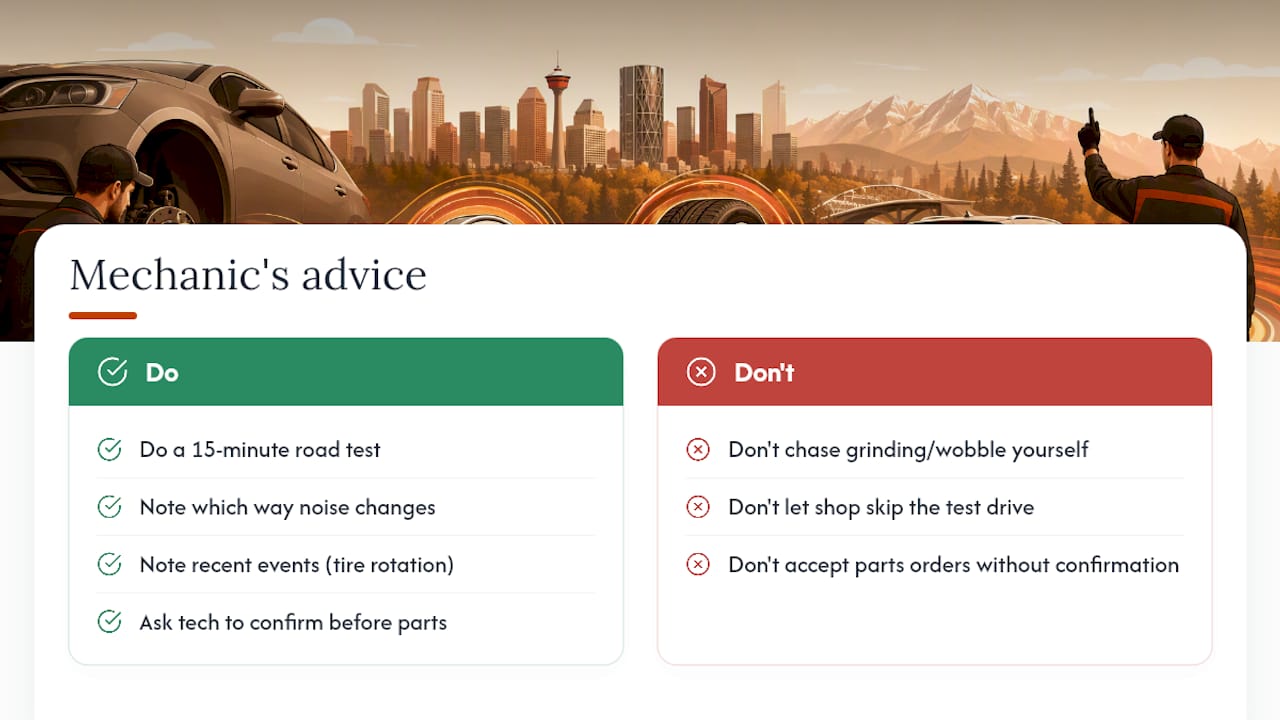
A DIY road test is worth doing every time this noise shows up. It's free, it takes fifteen minutes, and it usually narrows the problem down to one or two suspects before you spend a dollar. What isn't worth doing yourself is chasing the exact cause past that point, especially once grinding or wobble enters the picture. That's a safety threshold, not a puzzle to keep solving in your driveway.
The single biggest lever you have with a technician is your notes. Tell them the noise gets louder swerving right, not left, and that it disappeared for ten kilometres after you rotated the tires. That kind of detail steers a shop toward a road test and a hub check instead of a guess. Ask them to confirm the diagnosis before ordering parts, and be a little skeptical of any quote that skips the test drive entirely.
— Andrii
Get a second opinion before you pay for parts
If your test results are still murky, the smarter move isn't guessing again. It's getting a shop to confirm the diagnosis before anything gets ordered. A platform is designed to help you search and compare automotive shops by the service you need, such as tire rotation, suspension inspection, or diagnostics, instead of calling around blindly.
When you reach out to a shop through Garagemap, include your test notes: when the noise happens, which direction of steering makes it louder, and any photos of tread wear or cupping. Shops respond faster and quote more accurately with that information in hand. If you're in the Calgary area, start with the Calgary shop directory and compare a few options before you commit to a repair. And if tires turn out to be the culprit, Garagemap's tire shop listings will get you to a rotation or replacement without the runaround.
Sources
- Wheel bearing replacement cost | Driving
- Wheel bearing noise diagnosis | Auto Training Centre
- Symptoms of a worn wheel hub bearing | Timken