
Rotate your tires roughly every 5,000 to 8,000 miles or about every six months, whichever comes first. That's the baseline from most vehicle manufacturers and tire makers. Drive an EV, tow regularly, or run performance tires? Rotate sooner. Always cross-check your owner's manual, and inspect your tires between visits for uneven wear.
TL;DR:
- Rotate tires every 5,000 to 7,500 miles or about every six months, with more frequent rotation recommended for EVs, towing, or performance tires.
- Address uneven wear, pulling, vibrations, and unusual noise immediately, as these issues can indicate underlying alignment or suspension problems that accelerate tire degradation.
- Use appropriate rotation patterns based on drivetrain and tire type, such as front cross, rearward cross, or diagonal X, especially for AWD and non-directional tires.
- Ensure rotation costs around $60, takes 15 to 30 minutes, and is properly documented with receipts showing date, mileage, and tire positions to protect warranty claims.
- Stick to a consistent schedule aligned with oil changes or seasonal swaps instead of precise mileage, and keep detailed records for warranty validation.
Table of Contents
- Tire rotation frequency: what the manufacturers actually recommend
- Signs you shouldn't wait for the calendar
- Rotation patterns depend on your drivetrain and tire type
- What a rotation actually costs, and how long it takes
- The rotation checklist a good shop should run every time
- Why the first rotation matters more than people think
- Rotation, your warranty, and why record keeping isn't optional
- The upside of rotation goes beyond even tread wear
- How GarageMap helps you find a shop that does rotation right
- What actually matters here, and what drivers overload themselves with instead
- Sources
Tire rotation frequency: what the manufacturers actually recommend
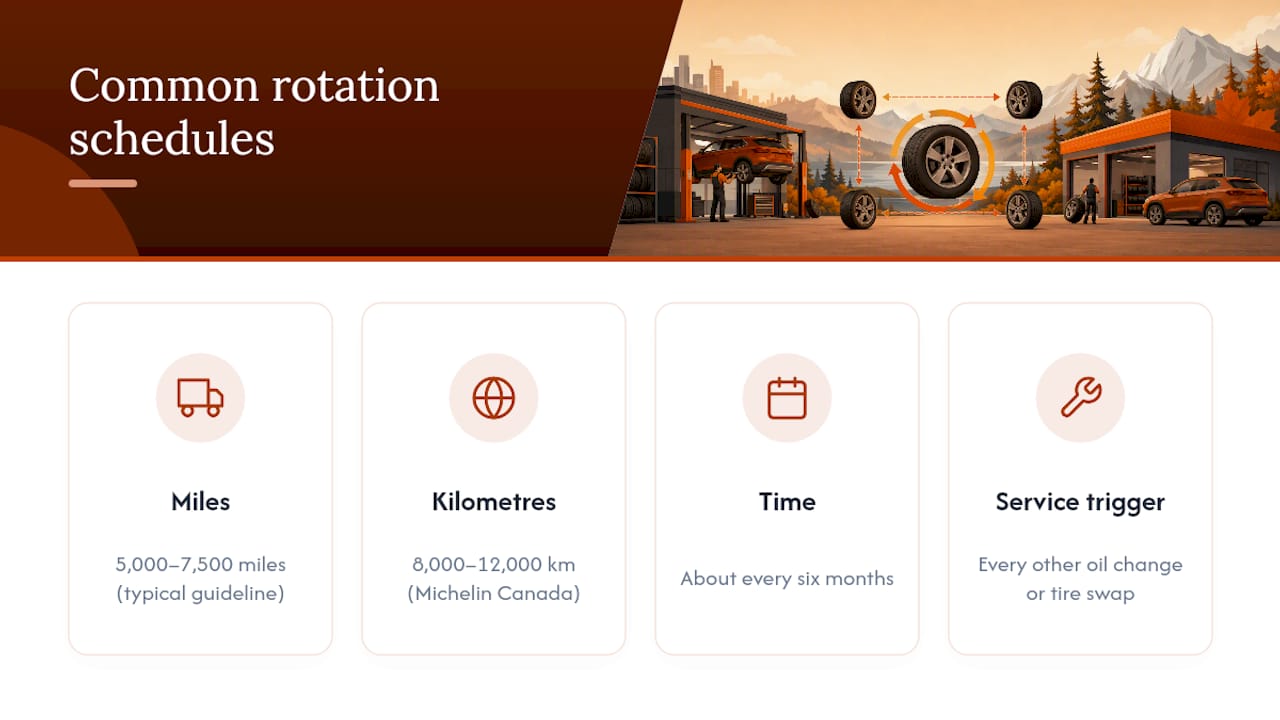
The numbers vary slightly by source, but they cluster tightly. Bridgestone Canada puts the general rule at every 5,000 to 8,000 miles or every six months, with the ideal interval depending on your vehicle type and how you drive. Consumer Reports tightens that slightly, recommending 5,000 to 7,500 miles based on independent testing. Michelin Canada frames it in metric terms instead, suggesting every 8,000 to 12,000 kilometres, which lines up closely with the mile-based figures once you do the math.
If your owner's manual gives an exact number, follow that over any generic guideline. Manufacturers set intervals based on the specific suspension geometry and tire specs of your model, and that trumps a rule of thumb every time.
Here's how the common ranges break down: the typical guideline is rotating tires roughly every 5,000 to 7,500 miles (or 8,000 to 12,000 kilometres), about every six months, or aligned with every other oil change, which many drivers use as a practical schedule.
If you swap between winter and summer tires twice a year, you already have a built-in rotation point. Michelin notes that a seasonal tire swap is a convenient moment to rotate positions on the vehicle at the same time, so ask your shop to do both in one visit rather than paying for two separate appointments.
Signs you shouldn't wait for the calendar
Uneven wear doesn't always wait politely for your next scheduled rotation. Watch for these signs that mean it's time to act now, not later:
- Uneven tread depth between tires, or noticeable cupping and scalloping on the tread surface.
- The car pulls to one side on a flat, straight road with no steering input.
- A vibration through the steering wheel that changes with speed, often a balance issue rather than rotation timing.
- Louder road noise from one tire, which can signal wear concentrated on the shoulder or centre of the tread.
Some of these point to something beyond rotation timing. Pulling and vibration often trace back to alignment or suspension problems, and wheel alignment issues accelerate tire wear in ways rotation alone can't fix. A misaligned vehicle will chew through a freshly rotated set just as fast as it did the old one.
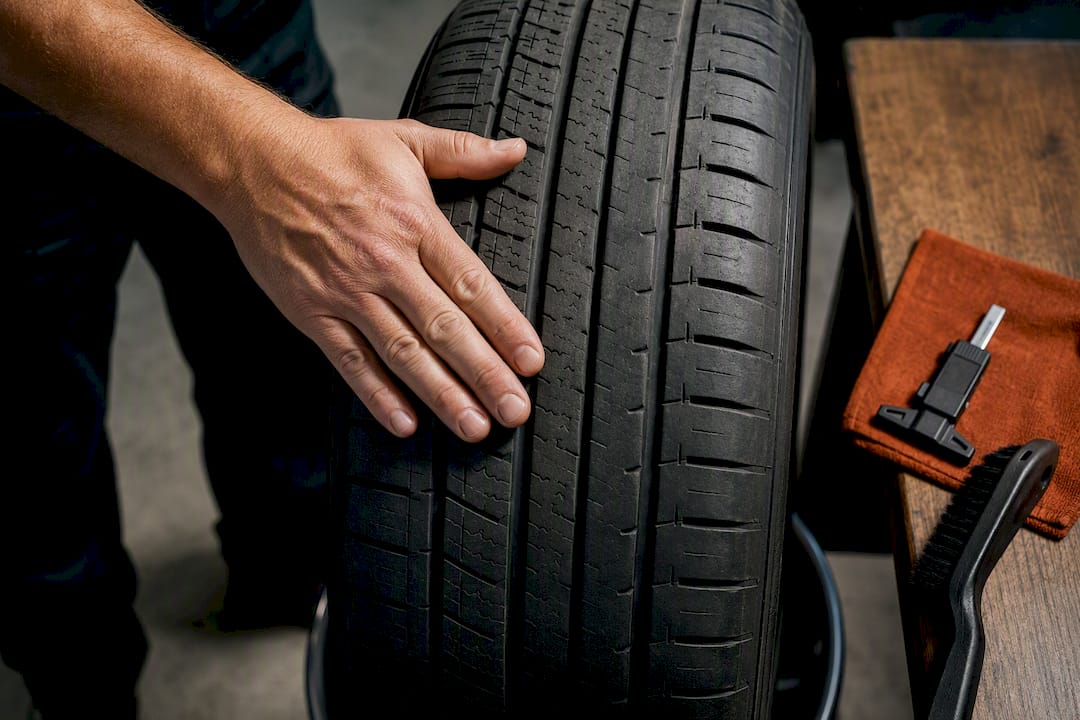
Pro Tip: Run your hand across each tire's tread, not just a visual glance. Cupping and feathering show up as texture changes you'll feel before you'll see them in dim garage lighting.
Acting early here protects both your safety margin and your tire warranty, since most manufacturers expect documented, timely rotations as a condition of tread life coverage.
Rotation patterns depend on your drivetrain and tire type
There's no single universal pattern. The right one depends on what's under your car and what kind of tires you're running.
- Front cross: rear tires move straight to the front; front tires cross to the rear. Common on front wheel drive (FWD) vehicles.
- Rearward cross: reverse of the above, typical for rear wheel drive (RWD) and some all wheel drive (AWD) setups.
- X pattern: all four tires cross diagonally, often used on vehicles with non directional tires and similar sizes front to rear.
- Side to side: used only on staggered fitments where front and rear tires are different sizes, limiting movement to the same axle.
AWD and 4WD vehicles tend to need tighter intervals because all four wheels share torque and wear more evenly, but also more aggressively. Electric vehicles push this further still, since instant torque and heavier curb weights accelerate tread wear, which is why some tire brands suggest leaning toward the 5,000 to 6,000 mile end of the range for EVs.
Directional tires can only rotate front to back on the same side, never side to side, because their tread pattern is designed to spin one way. If your vehicle carries a full-size spare, USTMA recommends folding it into the rotation pattern so wear stays even across all five tires instead of leaving one perpetually fresh in the trunk.
What a rotation actually costs, and how long it takes
Budget around $60 and 15 to 30 minutes for a standard rotation, based on typical shop pricing tracked by Consumer Reports. Plenty of shops rotate for free if you bought your tires there, and some throw it in as part of a maintenance package or seasonal swap deal, so it's worth asking before you pay out of pocket.
Bundling helps on both cost and time. Getting a rotation done alongside an oil change or a seasonal tire swap means one shop visit instead of two, and most shops will do it without extra labour charges if you're already booked in.
Before you leave the shop, confirm:
- You get a receipt showing the date and mileage at time of service.
- The shop recorded which tires moved where, especially if you're tracking wear patterns.
- Tire pressure was checked and adjusted for each new wheel position, not left at whatever it was before rotation.
A directory like GarageMap's tire shop listings makes it easier to compare shops across Calgary, Airdrie, Chestermere, and Okotoks before booking, rather than guessing which one actually includes free rotation with a tire purchase.
The rotation checklist a good shop should run every time
A rotation done right is more than four tires swapping corners. USTMA's tire care guidance lays out the full checklist a shop should follow:
- Check and adjust tire pressure for each wheel's new position.
- Inspect for uneven wear, cupping, or sidewall damage before remounting.
- Check wheel balance if vibration or wear patterns suggest it's needed.
- Torque lug nuts to the manufacturer's specification, not just "snug."
- Flag any signs that point to an alignment check, rather than ignoring them.
On your end, keep a simple log: date, mileage, shop name, and any recommendations made. That record matters more than most drivers realize. Tire makers including Continental require documented rotation history to honour tread life warranty claims, and a scribbled note in your glovebox is often the only proof you'll have years later.
Why the first rotation matters more than people think
The first rotation carries outsized importance, and it's the one most new-vehicle owners skip without realizing the cost. New tires start wearing into position-specific patterns almost immediately, shaped by which corner they're mounted on, your suspension geometry, and your typical driving habits. Front tires on a front wheel drive car, for instance, wear faster on the shoulders from cornering and braking forces that the rear tires never experience in the same way.
Skip that first scheduled rotation, and USTMA notes those early wear patterns can become locked in. Even rotating the tires later won't fully reverse uneven wear that's already set. That's a permanent hit to total tread life, and it's avoidable with one simple appointment.
Your owner's manual usually specifies the first rotation interval explicitly, sometimes tighter than the ongoing schedule that follows. Manufacturers do this because new tires haven't yet developed the wear pattern the vehicle will eventually settle into, so catching it early matters more than catching it late. If you bought your vehicle new, mark that first interval on a calendar rather than trusting memory. It's the one rotation appointment that's genuinely harder to undo if missed.
Rotation, your warranty, and why record keeping isn't optional
Most tire warranties come with a rotation requirement buried in the fine print, and it's the clause drivers discover only after a claim gets denied. Manufacturers build tread life warranties around the assumption that tires wear evenly, and even wear only happens with consistent rotation on schedule. Skip rotations, and you void the very protection you paid for when you bought the tires.
This is where a simple log becomes financial protection, not busywork. Keeping a record of date, mileage, and shop name at each rotation gives you the paper trail a warranty claim requires. Continental's guidance is blunt on this point: documented rotation history is often the deciding factor in whether a claim gets approved, because it proves you followed the maintenance schedule the warranty assumes.
Most shops will print or email a service receipt automatically, so the record keeping burden isn't heavy. What trips people up is losing those receipts over the two or three years between claims. A dedicated folder, a phone photo of each receipt, or a simple spreadsheet entry after every visit solves this. It takes ninety seconds and it's the difference between a covered claim and an argument with a warranty department that has no proof you did your part.
The upside of rotation goes beyond even tread wear
Even tread wear is the headline benefit, but it's not the only one. Rotated tires distribute the vehicle's grip more predictably across all four corners, which matters most in exactly the moment you don't want surprises: hard braking on wet pavement or an emergency lane change.
Fuel economy takes a smaller but real hit from uneven wear too. Tires that wear unevenly create more rolling resistance in some positions than others, and that unevenness adds up over the life of a set. Rotation keeps resistance consistent, which keeps fuel consumption more predictable.
There's also a straightforward economic case. A full tire set typically needs replacing all at once when wear is even. Skip rotations, and you often end up replacing tires two at a time as the front (or rear) pair wears out well before the others, which usually costs more over the tire's total lifespan than buying a matched set once. Consistent rotation stretches the useful life of the whole set and reduces how often you're back at a tire shop paying for a partial replacement instead of a full one.
How GarageMap helps you find a shop that does rotation right
Finding a shop that handles rotation properly, and actually documents it, shouldn't take an afternoon of phone calls. GarageMap compares 128 vetted shops across Calgary, Airdrie, Chestermere, and Okotoks, letting you filter specifically for tire services instead of scrolling through listings for engine work or bodywork you don't need.
Using a vetted shop matters for warranty purposes too. A shop that checks pressure, torques lug nuts to spec, and hands you a proper receipt gives you the documentation your tire warranty likely requires. When you're comparing options on GarageMap, filter for shops that bundle rotation with tire purchases or seasonal maintenance packages. That single filter can save you the standalone $60 fee most shops charge for a rotation on its own.
What actually matters here, and what drivers overload themselves with instead
The mileage and time numbers matter less than most articles make them sound. Whether you rotate at 5,000 miles or 7,500 doesn't move the needle much on your tire's total lifespan. What actually matters is consistency, and that's the piece most advice glosses over in favour of chasing the "perfect" number.
Here's where conventional guidance falls short: it treats every driver like they've got a spreadsheet tracking exact mileage. Most people don't. If you're the type who'll forget a precise interval, anchor your rotation to something you already do reliably, your oil change, your seasonal tire swap, or a fixed calendar date. A slightly imperfect but consistent schedule beats a technically ideal one you abandon after two visits.
The other overlooked piece is documentation, not the rotation itself. Drivers obsess over the exact mileage number and then lose the receipt that would've protected a warranty claim. If you do one thing differently after reading this, make it the log, not the math. Find a shop through a comparison tool, book the appointment around something you already have on your calendar, and keep the paperwork. That's the whole system.
— Andrii
Sources
- How often to rotate tires? | Bridgestone Canada
- How Often Should You Rotate Your Tires? | Consumer Reports
- Tire rotation guide | Michelin Canada