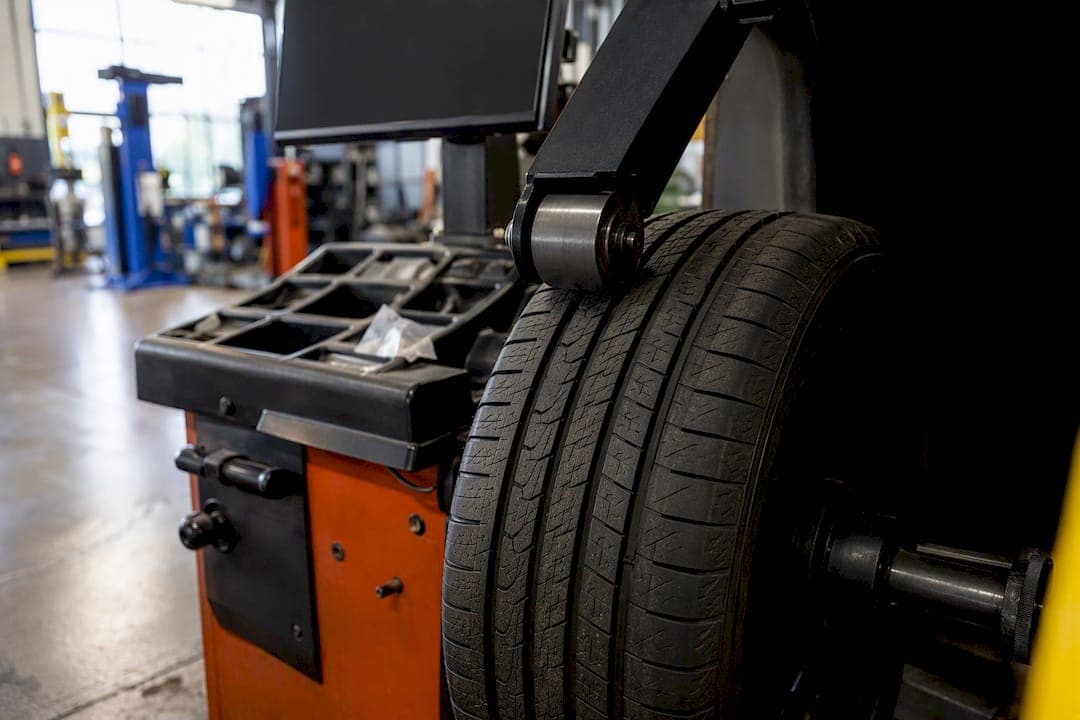
Road force balancing is an advanced test that simulates vehicle load to find force and runout problems a standard spin balance can miss. Use it when vibration persists after a conventional balance, when you're running low-profile or oversized tires, or when a brand-new tire shakes the wheel right out of the box. The machine does this with a roller that presses against the tread while the wheel spins, mimicking the weight the tire carries on the road. Hunter is the name you'll hear most often at the counter, since its Road Force machines are the industry's most common reference point.
Quick recommendation triggers:
- Vibration that survives a standard balance
- Low-profile, performance, or oversized truck tires
- A new tire that shakes immediately after mounting
- Vibration that comes back after a rotation
Key Takeaways
Road force balancing finds structural force variation and runout that a standard spin balance cannot detect because it never tests the tire under simulated load.
| Point | Details |
|---|---|
| Try standard balance first | Road force balancing costs roughly double, so reserve it for vibration that survives a regular balance. |
| Watch for high-risk tire types | Low-profile, performance, and oversized truck tires are more likely to show noticeable vibration from small force variations. |
| Ask for before/after numbers | A shop recommending replacement should show documented radial force and runout readings, not just an opinion. |
| Know the fix hierarchy | Shops typically try match-mounting and bead massage before recommending wheel repair or tire replacement. |
| Use GarageMap to compare shops | Search GarageMap's tire directory across Calgary, Airdrie, Chestermere, and Okotoks to find shops equipped for road force balancing. |
Table of Contents
- What does road force balancing actually measure?
- Road force balance vs regular balancing: what's the real difference?
- When does road force balancing make sense for your vehicle?
- What happens during a road force balancing appointment?
- How do technicians actually fix what the machine finds?
- Choosing the right test and reading a shop's recommendation
- Find a shop that actually offers road force balancing
- Sources
What does road force balancing actually measure?
A standard spin balancer spins a wheel in the air and checks for weight imbalance. Road force balancing goes further: a heavy roller, typically applying somewhere around 1,200 to 1,400 pounds of pressure, presses against the tread to recreate the load the tire feels under the vehicle's actual weight. That load reveals something a free-spinning wheel never shows: how consistently stiff the tire is all the way around.
The machine tracks a few key numbers while it does this. Radial force variation measures how much the tire pushes back unevenly as it rotates under load, and this variation, not simple weight imbalance, causes much of the vibration owners complain about. Lateral force variation checks side-to-side inconsistency, and runout measures how much the wheel or tire wobbles out of round.
Statistic Callout: A tire can be perfectly weight balanced and still shake the steering wheel at highway speed if one section of the sidewall is stiffer than the rest. That's the blind spot standard balancing has always had.
Machine features like Hunter's ForceMatch and SmartWeight automate the math behind fixing what the roller finds, while WalkAway systems run the whole cycle without a technician standing there the entire time. None of that changes the underlying physics. It just makes the fix faster and more consistent.
What the numbers point to:
- High radial force variation: usually fixed by rotating the tire on the rim
- High runout: points toward a wheel or tire defect, not a weight problem
- Both low but vibration persists: look outside the tire and wheel entirely
Road force balance vs regular balancing: what's the real difference?
Standard balancing corrects static and dynamic weight imbalance. It answers one question: is weight distributed evenly around the wheel and tire assembly? Road force balancing answers a second, harder question: does the tire behave consistently once it's carrying real weight?
That distinction shows up in the shop bay constantly. A tire that passes a standard balance with flying colours can still cause a steady shimmy in the seat or steering wheel at 100 to 110 km/h, because the balancer never tested it under load in the first place.
Side-by-side, here's what separates the two:
- What it corrects: standard fixes weight distribution; road force fixes structural uniformity
- How it tests: standard spins freely; road force loads the tread with a roller
- What it catches: standard misses stiff spots and runout entirely
- When it's needed: standard is fine for most cars; road force comes in when vibration won't quit
When does road force balancing make sense for your vehicle?
Not every car needs this test, and no shop should push it on every customer. It earns its keep in specific situations.
- Vibration that changes with speed, especially in the 90 to 120 km/h range
- Vibration felt in the steering wheel (often a front tire issue) versus the seat or floor (often a rear tire issue)
- A pull to one side that a standard balance and alignment didn't resolve
- Repeated visits for the same shimmy after two or more standard balances
- Low-profile, performance, or oversized all-terrain tires, where small force variations translate into noticeable shake
- A brand new tire that vibrates before it's even worn in, suggesting a manufacturing defect
Pro Tip: Ask the shop to road force balance a new tire before you drive it home if it feels off in the parking lot. Catching a defective tire before the return window closes saves you a fight with the manufacturer later.
Expect to pay roughly double what a standard balance costs. Most guides for this comparison point to a range near $80 to $160 for four tires versus $40 to $80 for a standard spin balance, though pricing varies by shop and region. That extra cost is usually cheaper than replacing a tire that didn't actually need to go.
What happens during a road force balancing appointment?
The process follows a fairly predictable sequence, whether the shop is running a Road Force Elite or a WalkAway unit.
- Visual inspection of tire wear, wheel condition, and existing weights
- A standard spin balance first, to correct basic weight imbalance
- Road force measurement, with the roller applying load and logging radial and lateral variation plus runout
- A recommended fix based on what the numbers show
- A re-test to confirm the vibration source is resolved
Statistic Callout: Expect roughly 10 to 15 minutes per tire for the road force portion alone, on top of the standard balance, so budget approximately an hour for all four when a shop is thorough about it.
Most sessions end with one of three outcomes: weights added or repositioned, the tire remounted at a different position on the wheel (match-mounting), or a bead massage to reseat the tire properly. Replacement only gets recommended when runout or force variation stays high after those fixes, or when the defect is severe enough that remounting can't correct it.
How do technicians actually fix what the machine finds?
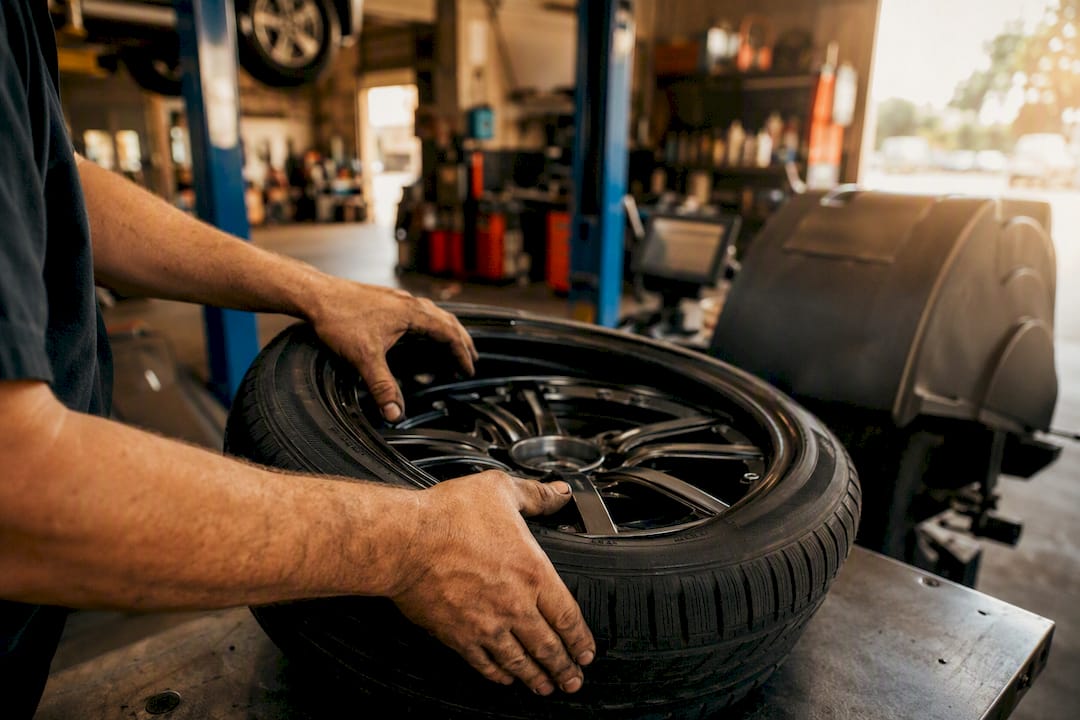
Match-mounting, sometimes called force matching, is the workhorse fix. It pairs the tire's stiffest point (its "high spot") with the wheel's lowest point, and that pairing cancels out much of the radial force variation without adding a single extra weight. Done correctly, it resolves a surprising number of vibration complaints that owners assumed meant a bad tire.
Bead massage is a smaller fix: the tire is deflated slightly and flexed to help the bead seat evenly against the rim. It solves seating problems but won't touch a genuine manufacturing defect in the tire's structure.
Runout checks matter just as much as force numbers. Training references commonly cite limits around 1.1 mm radial and 1.3 mm lateral runout for typical aluminum wheels; runout beyond that points to a bent or defective rim rather than anything match-mounting can solve.
A few things worth knowing before you agree to any fix:
- Cold tires can throw a false high reading, so many shops drive tires briefly to warm them before testing
- A single high force number shouldn't condemn a tire on its own without correlating it to actual symptoms and runout
- If force and runout both check out clean and the vibration is still there, the cause is likely suspension, driveline, or a bent axle, not the tire at all
Pro Tip: If a shop recommends new tires based on road force numbers alone, ask to see the actual readings before and after match-mounting. A shop confident in its diagnosis will show you the printout without hesitation.
Choosing the right test and reading a shop's recommendation
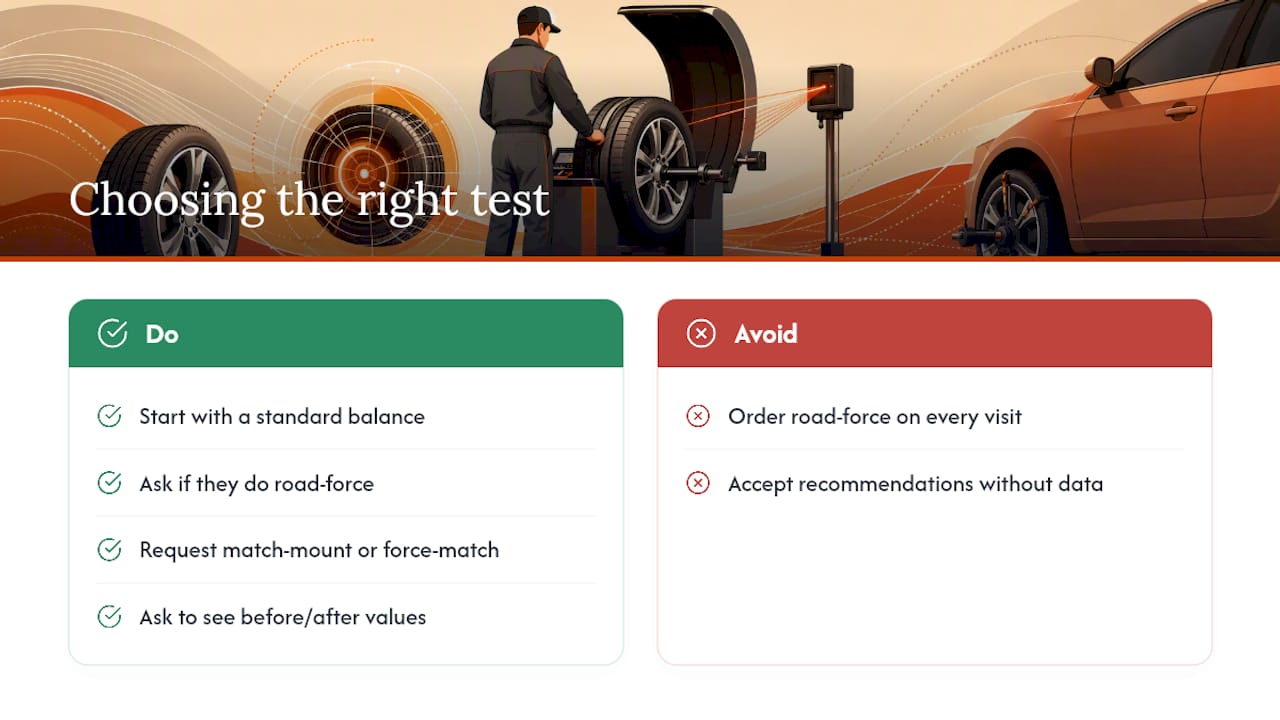
My honest take: most drivers never need road force balancing, and a shop that runs it on every single visit regardless of symptoms is padding the ticket. Start with a standard balance. If the vibration survives that, then ask for road force.
Come prepared with three questions: "Do you perform a road force measurement?", "Will you match-mount or force-match before recommending anything else?", and "Can you show me the before and after values?" A shop that hesitates on that last one is guessing, not diagnosing. GarageMap exists partly to help you skip that guessing game by connecting you with shops that list this exact capability upfront.
— Andrii
Find a shop that actually offers road force balancing
Not every tire shop owns a Road Force machine, and calling around to check is a waste of an afternoon. GarageMap is a directory built for exactly this problem: search by service type across Calgary, Airdrie, Chestermere, and Okotoks, and filter down to shops that handle advanced tire balancing and diagnostics rather than sifting through general listings that may or may not have the right equipment.
Start with the tire shop directory to see which providers near you list balancing and diagnostic work, and check the suspension and steering listings if your vibration turns out to be a chassis issue rather than a tire one. If you're in Calgary specifically, the Calgary repair shop page narrows the search down to your area. Compare a couple of shops, confirm they run road force measurements, and book the appointment that actually matches your symptoms.
Sources
- Road Force® WalkAway™ Wheel Balancer
- Road Force Balancing: When to use on Your Customer's Vehicles
- Road Force Balancing
- BMW technical training module — Road Force balancing (archived)