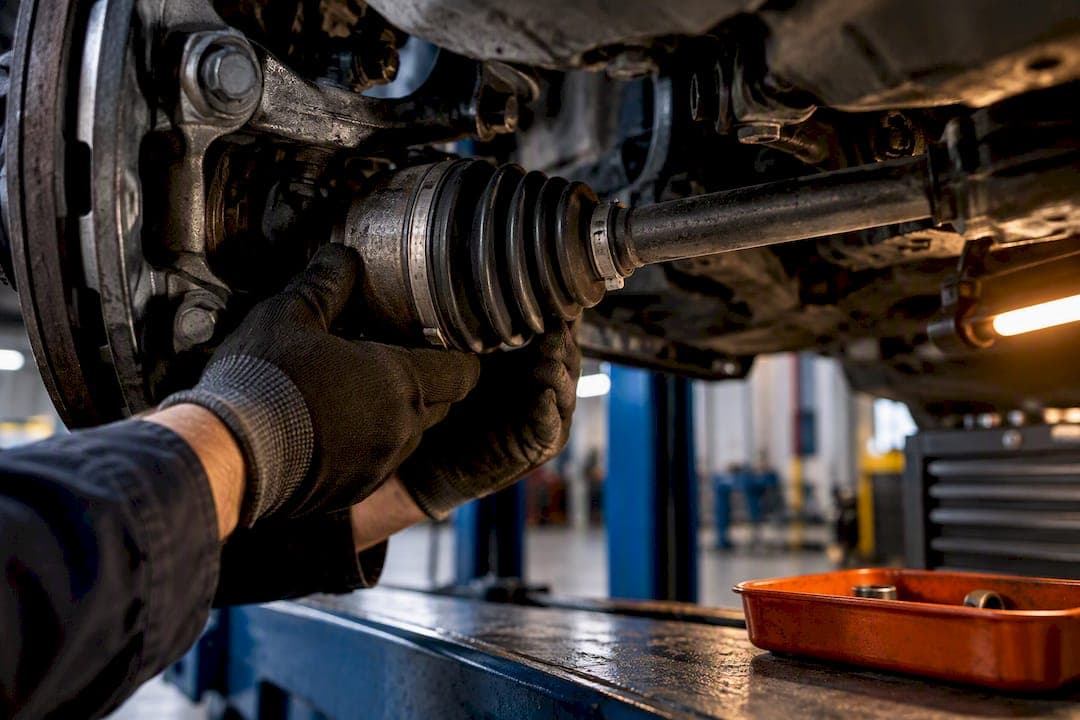
If you hear a rhythmic clicking when turning, or a clunk under throttle and see grease on the wheel well, the CV axle almost certainly needs attention. Once clicking or clunking starts, plan on replacement rather than a quick patch. A fresh boot tear with no noise yet is the one exception worth acting on fast, before grease loss turns a cheap fix into a full axle job.
TL;DR:
- Grease on the wheel well indicates a torn CV boot, which should be replaced before noise or grease loss lead to axle failure.
- Clicks when turning signal outer joint wear, while clunking on acceleration points to issues with the inner joint or loose splines.
- Most diagnoses can be made in a parking lot with slow circles, steering full lock turns, and visual inspection of boots and grease.
- Driving on a torn boot with no noise may be tolerated short-term, but active clicking requires immediate repair to prevent roadside failure.
- Replacing the entire axle is generally more reliable and cost-effective than repairing a contaminated boot, especially on older vehicles.
Table of Contents
- What are the clearest cv axle replacement signs?
- How to test for a bad CV axle yourself
- What else can mimic a failing CV axle?
- Is it safe to keep driving on a bad CV axle?
- Should you repair the boot or replace the whole axle?
- How to find a shop you can trust for CV axle work
- What the noise is really telling you
- Get quotes from vetted shops before the joint fails completely
- Sources
- FAQ
What are the clearest cv axle replacement signs?
The CV axle (constant velocity axle) connects your transmission to the wheels and lets power flow smoothly through the suspension's full range of motion. Each end has a joint wrapped in a rubber or thermoplastic boot packed with grease. Wear shows up differently depending on which joint is failing, and learning that difference tells you almost everything a mechanic needs to know before you even open the hood.
Clicking or popping while turning is the textbook symptom of a worn outer joint, and it gets louder the sharper you turn. Drivers usually notice it pulling out of a parking spot or rounding a tight corner at low speed. It is one of the most reliable bad CV axle symptoms because almost nothing else produces that specific rhythmic click tied directly to steering angle.
Clunking on acceleration or during a shift from drive to reverse points to the inner joint instead. That knock happens when worn splines or a loose joint take up slack the instant torque loads the axle. Vibration under acceleration that intensifies as you press the gas, rather than simply climbing with road speed, often traces back to that same inner joint or a bent shaft.
A few other clues matter just as much as sound:
- Grease flung across the inside of the wheel rim or wheel well means a boot has split and lubricant is escaping.
- A visibly torn or cracked boot, even without noise yet, signals contamination is only a matter of time.
- Steady vibration that scales with speed on smooth and rough pavement alike usually means something other than the axle, covered in the misdiagnosis section below.
Pro Tip: Grease on the wheel well is the cheapest CV axle warning you'll ever get. Catch it before the joint starts clicking and a boot replacement can save you the cost of the whole axle.
Once the joint is actually clicking, the clock is already running. The gap between first noise and total failure varies a lot and can shrink to a matter of days once the joint runs dry, so treating early clicking as a "someday" problem carries real risk.
How to test for a bad CV axle yourself
You don't need a lift to narrow down which side and which joint is failing. A few minutes in an empty parking lot will usually tell you more than guessing based on sound alone.
- Find an empty lot with room to make slow, tight circles in both directions.
- Turn the steering wheel to full lock (as far as it goes) and drive a slow circle to the right, listening for clicking.
- Repeat at full lock turning left. Clicking on the right turn points to the right outer joint; clicking on the left points to the left outer joint.
- Back into an open space and alternate gently between drive and reverse, giving light throttle each time, to try to reproduce an inner-joint clunk.
- Park, then visually inspect both CV boots for tears, cracks, or grease slung onto the wheel or nearby suspension parts.
- With the wheel off the ground and safely supported, rotate the axle by hand to feel for roughness, grinding, or excess play, only if you have proper jack stands and know how to support the vehicle safely.
The full-lock circle test is the single most useful diagnostic here. It pinpoints the exact side that's failing and, in the same manoeuvre, tends to rule out a wheel bearing, since bearing noise doesn't change character with steering angle.
Pro Tip: Do these tests at low speed only. If you feel severe vibration, a grinding sensation through the steering wheel, or anything that feels like the wheel might bind, stop immediately and get the car inspected rather than pushing through the test.
What else can mimic a failing CV axle?
A surprising number of unrelated problems produce noises drivers blame on the CV axle. Sorting them out before buying parts saves money and prevents chasing the wrong repair.
- Wheel bearings produce a steady hum or growl that gets louder with speed and often changes pitch when you gently sway the car left and right at low speed. It's not a click tied to turning like an outer CV joint.
- Unbalanced or bent wheels cause vibration that climbs steadily with speed on any road surface, rather than spiking specifically under acceleration.
- Worn ball joints or tie rods knock over bumps and can make the steering feel loose or wander, but they don't produce the sharp click of a failing outer joint.
- Brake issues show up as grinding or pulsing specifically when you apply the brakes, not while turning or accelerating.
A quick rock test (grabbing the tire at the 12 and 6 o'clock positions and checking for play) helps separate a bearing problem from an axle problem before you commit to a repair.
Is it safe to keep driving on a bad CV axle?
It depends on what stage you're at. A boot that's torn but still quiet, with grease loss and no clicking yet, can sometimes tolerate a short, careful drive to a shop, though you shouldn't put it off. Once you hear rhythmic clicking in turns, treat replacement as near-term rather than optional.
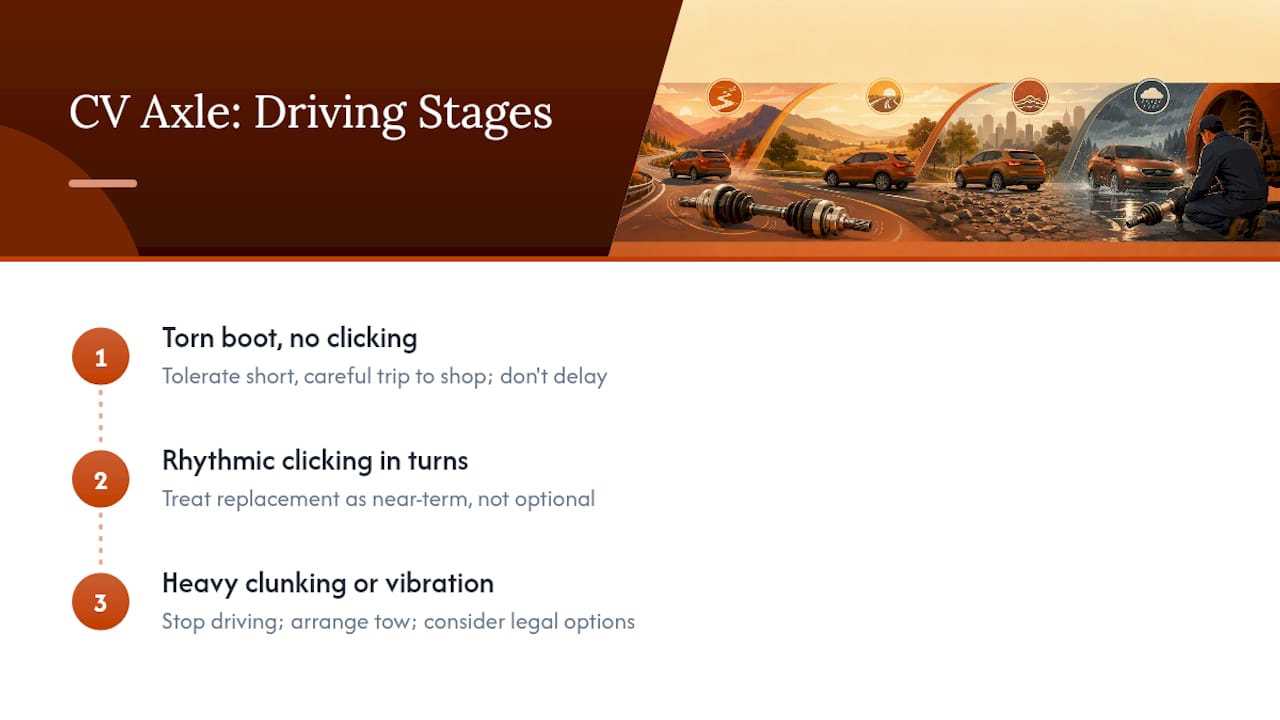
Heavy clunking, severe vibration, or any sign the wheel is losing drive means stop driving and arrange a tow, and consider your legal options as outlined in Nissan Lemon Law CVT – Protecting Your Rights Against Faulty Transmissions - Quill and Arrow Law. A joint that seizes or separates can cause a sudden loss of control, and that risk isn't worth a few kilometres of savings. If you must move the car short distances, avoid highways, keep speeds low, skip carrying extra weight, and drive straight to a repair shop.
Should you repair the boot or replace the whole axle?
Catching a torn boot early, while the grease inside is still clean and the joint hasn't run dry, is the one scenario where a boot replacement and repack can actually save the joint. Once grit and moisture get in, that window closes fast, and a repacked boot on a contaminated joint will often click again almost immediately.
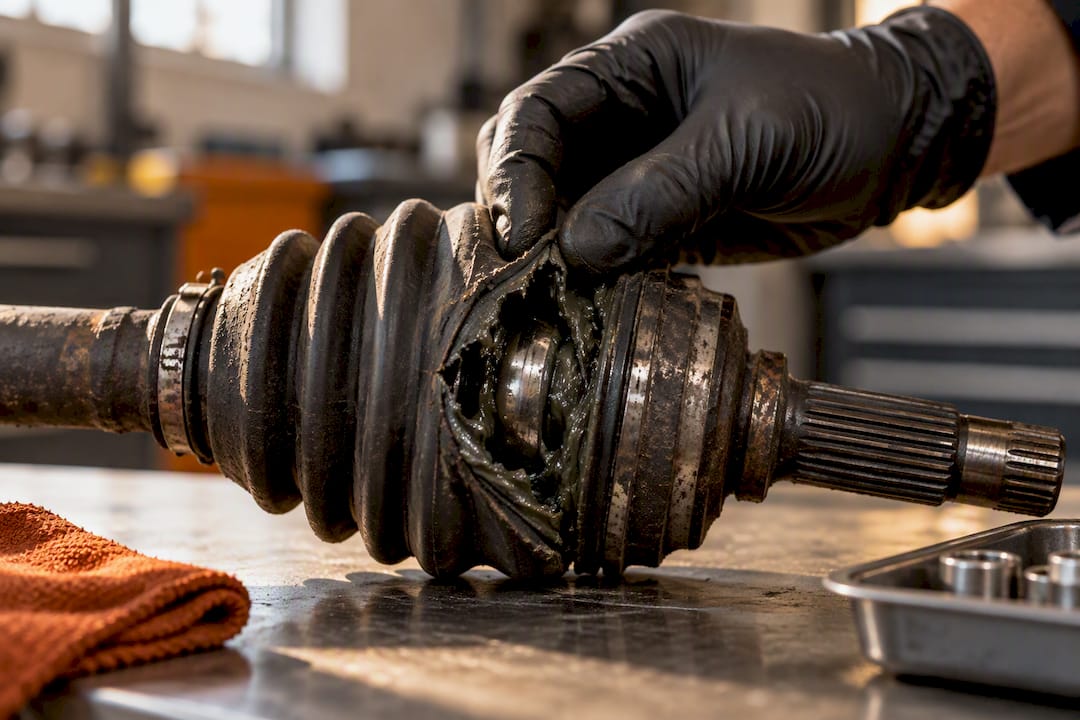
That's why most shops replace the entire CV axle assembly rather than repairing individual components. It's more reliable, avoids hidden damage inside a joint you can't fully inspect, and tends to cost less overall once labour is factored in. You'll typically be offered new, remanufactured, or tested used axles, with price scaling accordingly.
A few things drive the final quote:
- Whether you choose new, remanufactured, or used affects both part cost and warranty length.
- Corroded axle nuts or seized fasteners add labour time on older vehicles.
- Vehicles with ABS sensors built into the axle need a compatible tone ring, which limits your part options.
Pro Tip: Before calling for quotes, have your VIN ready, note which side is clicking or clunking, and snap a photo of any grease or boot damage. Shops can quote faster and more accurately with that information up front.
How to find a shop you can trust for CV axle work
Ask any shop three things before booking: do they confirm the correct part by VIN, what's the warranty on parts and labour, and do they offer both new and remanufactured axle options. A shop that hesitates on any of those is worth skipping.
GarageMap lets you filter local shops by service type, whether that's engine diagnostics or suspension work, and request quotes from several vetted shops around Calgary, Airdrie, Chestermere, and Okotoks at once. Bring your symptom notes, the side that's clicking, any grease photos, and your VIN, and you'll get comparable quotes without calling shop after shop yourself.
What the noise is really telling you
Most drivers treat CV axle noise as background information, something to mention next time they're in for an oil change. That's backwards. A clicking outer joint or a clunking inner joint is one of the few drivetrain symptoms you can diagnose yourself with total confidence, using nothing but an empty parking lot and a few slow circles.
The bigger mistake I see in conventional advice is treating "keep an ear out" as sufficient guidance. It isn't. The gap between first click and total failure isn't predictable, and a joint that runs dry can go from noisy to seized faster than most owners expect. Precision matters more than patience here.
What actually moves the needle is doing the full-lock test the first time you hear anything unusual, checking the wheel wells for grease before you even start the car, and walking into a shop with the failing side already identified. That turns a vague complaint into a five-minute diagnosis, and it's the difference between a $300 boot repair and a full axle replacement you could have avoided by acting two weeks earlier.
— Andrii
Get quotes from vetted shops before the joint fails completely
This platform lets you request quotes from multiple vetted shops without calling each one individually. Instead of guessing which garage actually specializes in driveline work, you filter by service, in this case engine diagnostics or suspension repair, and request quotes directly from shops that already list that capability.
If you've already run the full-lock test and know which side is clicking, or you've spotted grease in the wheel well, that's exactly the information a shop needs to quote you accurately. Search shops in Calgary, Airdrie, or Okotoks, send your symptoms and VIN, and compare quotes side by side before you book. Start your search at Garagemap and get the axle sorted before a $300 boot job turns into a full replacement.
Sources
FAQ
How urgent is a CV axle replacement?
It depends on the symptom stage. A quiet, freshly torn boot allows a short window to get it inspected, but once you hear rhythmic clicking or clunking, treat it as a near-term repair rather than something to schedule for next month.
Can I drive if my CV axle is bad?
You can sometimes drive short, careful distances if the only sign is a fresh boot tear with no noise, but heavy clunking, severe vibration, or any hint of lost drive means you should stop and arrange a tow. A joint that seizes while driving can cause a sudden loss of control.
What can be mistaken for a bad CV axle?
Worn wheel bearings, unbalanced or bent wheels, loose ball joints or tie rods, and even brake issues can all mimic CV axle noise. A quick way to tell them apart: wheel bearing noise hums steadily and changes with a side to side sway test, while a true CV click only appears when turning.
What is the lifespan of a CV axle?
There's no fixed mileage figure, since it depends heavily on boot condition and driving conditions like potholes and off road use. What matters more than age is the boot: once it tears and grease starts escaping, the countdown to failure can shrink to days rather than months.
Does GarageMap help with CV axle repairs specifically?
Yes. You can filter by engine diagnostics or suspension service categories on GarageMap and request quotes from multiple vetted local shops using your VIN and symptom details, rather than calling shops one by one.