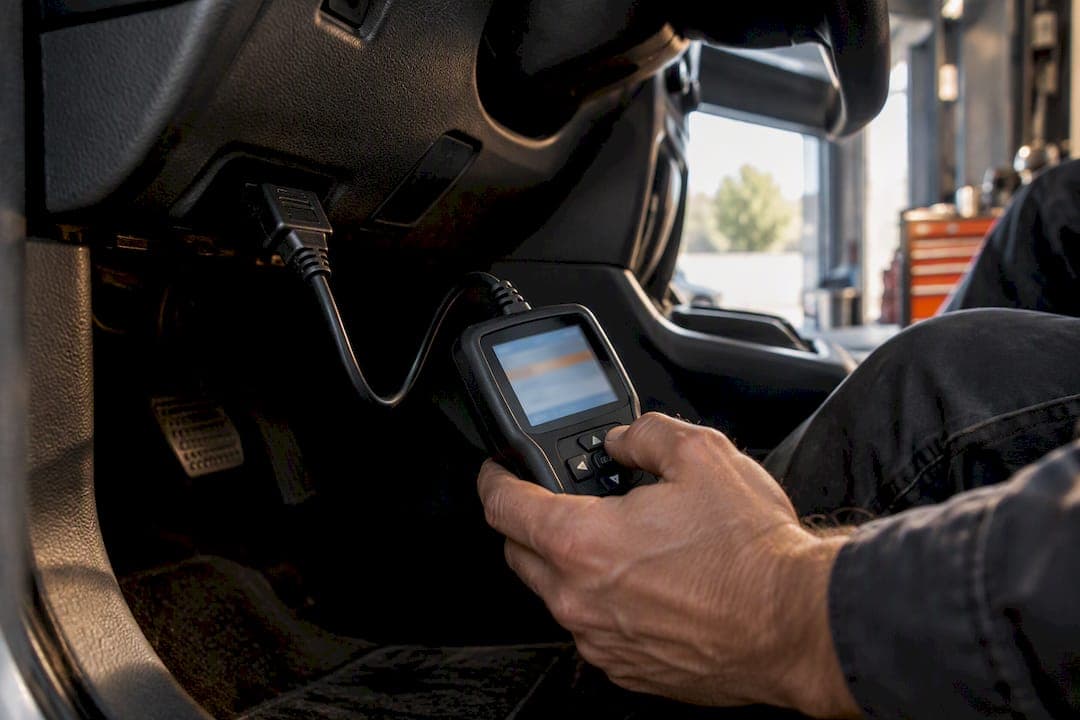
If your check engine light is on, chances are it's one of a handful of usual suspects: P0171/P0174, P0300, P0420, P0128, an EVAP code like P0441 or P0455, P0700, or U0100. The first move is always the same, read the code with a scan tool or ask a parts store to pull it, then treat that code as a starting point, not a confirmed diagnosis.
TL;DR:
- Most common codes like P0171 and P0174 suggest vacuum leaks, dirty sensors, or fuel pressure issues requiring visual checks before parts replacement; persistent problems may need professional testing.
- Freeze frame data helps identify whether faults occur at specific engine loads or speeds, guiding more accurate diagnosis rather than relying solely on code interpretation.
- Basic scan tools only detect stored codes; resolving intermittent or complex faults often requires advanced equipment like smoke tests, wiring inspections, or compression checks performed by professionals.
- Checking simple items such as the gas cap, vacuum hoses, and battery terminals can often eliminate many false triggers before visiting a shop, saving time and money.
- Recording detailed code information, freeze frame conditions, and symptoms beforehand helps technicians diagnose faster and prevents unnecessary part replacements.
Table of Contents
- How OBD‑II codes are structured
- Common OBD2 codes DIYers see
- Practical next steps before you replace any parts
- Reading the freeze frame data attached to a code
- Where OBD2 codes stop being enough
- Balancing DIY triage with professional diagnostics
- Find and compare engine diagnostics shops near you
- Sources
- FAQ
How OBD‑II codes are structured
Every OBD‑II diagnostic trouble code follows a five-character format, and once you know how to read it, any code on a scan tool report starts to make sense.
-
The first character names the system: P for powertrain, B for body, C for chassis, and U for network or communication faults.
-
The second character tells you whether the code is generic, shared across all manufacturers under SAE standards, or manufacturer-specific, meaning it applies to one brand's particular hardware or software.
-
The remaining three characters point to the specific system and fault, such as fuel metering, an injector circuit, or a misfire.
Within P-codes, the numbering follows a pattern worth remembering. Codes in the P0100 to P0199 range cover fuel and air metering, P0200 to P0299 covers injector circuits, P0300 to P0399 covers misfire and ignition problems, and P0400 to P0499 covers auxiliary emissions controls like EVAP and the catalytic converter. Manufacturer-specific codes exist because some systems, like advanced transmission controls or hybrid components, don't have a generic SAE definition, so the automaker writes its own. Those matter mainly if your generic scan tool cannot pull them, which is when a dealership-level or manufacturer-specific tool becomes worth the trip.
Common OBD2 codes DIYers see
These are the codes that show up again and again on general vehicles. Each one includes a quick check you can try yourself and a sign that it's time to call a shop.
- P0171 / P0174, system too lean (bank 1 / bank 2). The engine is getting too much air or too little fuel. Common causes include vacuum leaks, a dirty or failing mass airflow sensor, weak fuel pressure, or a clogged injector. DIY check: inspect visible vacuum hoses for cracks, clean the MAF sensor, and confirm the gas cap is tight and undamaged. Call a shop if the lean condition persists after those checks or if fuel trims stay high under load.
- P0172, system too rich (bank 1). The opposite problem: too much fuel or too little air. It often traces to a leaking injector, a fuel pressure regulator stuck open, or a failing oxygen sensor. DIY check: look for a black, sooty smell from the exhaust or visible fuel smell under the hood. Call a shop for fuel pressure testing and injector flow checks if the smell or rough idle continues.
- P0300 and P0301 to P0308, misfire codes. P0300 means a random or multiple-cylinder misfire, while P0301 through P0308 point to a specific cylinder, with the final digit matching the cylinder number. Causes range from worn ignition coils and spark plugs to failing injectors, vacuum leaks, or low compression. Symptoms include rough idle, hesitation, stalling, and reduced fuel economy. DIY check: inspect spark plugs and coil connections for wear or corrosion. Call a shop if the misfire returns quickly or if you suspect a compression or internal engine issue.
- P0420 / P0430, catalyst efficiency below threshold. The catalytic converter isn't reducing emissions the way the computer expects. Before assuming the converter itself has failed, check freeze frame data and fuel trims, since a lean or rich condition, a failing oxygen sensor, or an exhaust leak can trigger this code without the converter being the actual problem. DIY check: look for exhaust leaks near the manifold or converter. Call a shop for oxygen sensor testing before paying for a replacement catalytic converter.
- P0128, coolant thermostat regulation. The engine is taking too long to reach normal operating temperature, usually because of a stuck-open thermostat or low coolant. DIY check: confirm coolant level is correct. Thermostat replacement resolves this in most cases, and it's a straightforward job for a confident DIYer.
- EVAP codes P0441, P0442, P0455, P0456. These flag purge flow or leak problems in the evaporative emissions system, with P0442 indicating a small leak, P0455 a large leak, and P0456 a very small leak. Loose gas caps, cracked hoses, and faulty purge valves are the most common culprits. DIY check: check the gas cap seal first. Call a shop for a smoke test if you don't find an obvious cause, since that's the standard next step when visual checks fail.
- P0700, transmission control malfunction. This code usually just flags that the transmission control module has stored its own fault. DIY check: none, really, beyond noting drivability symptoms. Call a shop to pull the specific transmission code, since P0700 alone doesn't tell you what's wrong.
- U0100, lost communication with the ECM or PCM. Before assuming a module has failed, check fuses, battery voltage, and grounds, since these communication faults commonly come from wiring or power issues rather than the module itself. DIY check: inspect the battery terminals and known ground points for corrosion. Call a shop for wiring harness diagnosis if the code returns after basic checks.
Pro Tip: Write down every code, plus whether the check engine light is steady or flashing, before you touch a single part. A flashing light means an active misfire that can damage the catalytic converter, so that drive should end at a shop, not a parts aisle.
Practical next steps before you replace any parts
A code tells you what test failed, not which part caused it. That distinction is worth repeating before you spend money.
- Start with the free checks: gas cap seated and undamaged, visible vacuum hoses intact, battery terminals clean and tight, and no obviously chafed wiring near the engine bay.
- Read pending codes as well as confirmed ones. A pending code means the fault has shown up once but hasn't repeated enough times to trigger the check engine light.
- Watch fuel trim numbers and oxygen sensor response if your tool shows live data. Numbers that swing far from zero or react slowly point toward a real fuel or air problem rather than a one-time glitch.
A basic code reader shows you the stored DTCs and clears the light. It typically won't give you bi-directional tests, full module coverage, or live data graphing, features found on shop-grade tools like the Autel MaxiSYS MS908S II. That gap explains why a home scan sometimes leaves you with a code but no clear answer.
The golden rule holds regardless of which tool you use: check your vehicle's service manual for the exact testing sequence for that code before swapping parts, since the same code can have different likely causes across makes and models. Book a shop visit for anything requiring a smoke test, a compression test, wiring harness diagnosis, or module programming, none of which a driveway toolkit handles well.
Reading the freeze frame data attached to a code
Freeze frame data is a snapshot of what the engine was doing the moment a code triggered: RPM, engine load, coolant temperature, fuel trims, and vehicle speed, among other values. It's stored specifically so a technician can recreate the conditions that caused the fault instead of guessing.
For a code like P0420, freeze frame data showing the fault appeared only at highway speed under heavy load points toward a heat-related or load-related cause, while a fault that appeared at idle suggests something different, like a sensor drifting out of range. For a misfire code, freeze frame data showing high engine load at the moment of the fault can point toward a fuel delivery or ignition problem under stress, rather than a constant issue. Compare the freeze frame numbers against what's normal for your engine at that RPM and load, since a fuel trim or temperature reading that's out of range at that specific moment is often the clue that narrows down the cause. Reputable diagnostic manuals treat freeze frame review as a standard step before any test or repair, not an optional extra.

Where OBD2 codes stop being enough
A code is a detection, not a diagnosis. The onboard computer flags that a test failed and stores freeze frame data around the moment it happened, but figuring out the actual cause is a separate job that sometimes needs more than a scan tool can offer.
Several situations push past what codes alone can resolve. Intermittent faults that don't reproduce on demand often need a smoke test, a wiring harness inspection, or a scope test to catch a signal that only misbehaves under specific conditions. Mechanical issues like low compression or a worn timing component won't show up as a specific code at all, even though they cause the symptoms that trigger one. Communication faults like U0100 need targeted electrical testing, checking grounds, fuses, and voltage under load, since guessing at a module replacement can mean paying for a part that was never the problem. And scan tool coverage itself varies by vehicle, protocol, and software version, so a basic reader might miss a code that a professional-grade tool with full module access would catch immediately. When checks at home don't resolve the code or the symptom keeps returning, that's the point to bring in equipment and testing a driveway can't match.

Balancing DIY triage with professional diagnostics
Reading and recording your codes before a shop visit saves everyone time. Note the exact code, whether it's pending or confirmed, the freeze frame conditions, and what the car was doing when the light came on, cold start, highway driving, right after fuelling up. A tech who starts with that information skips a step and gets to testing faster.
— Andrii
Find and compare engine diagnostics shops near you
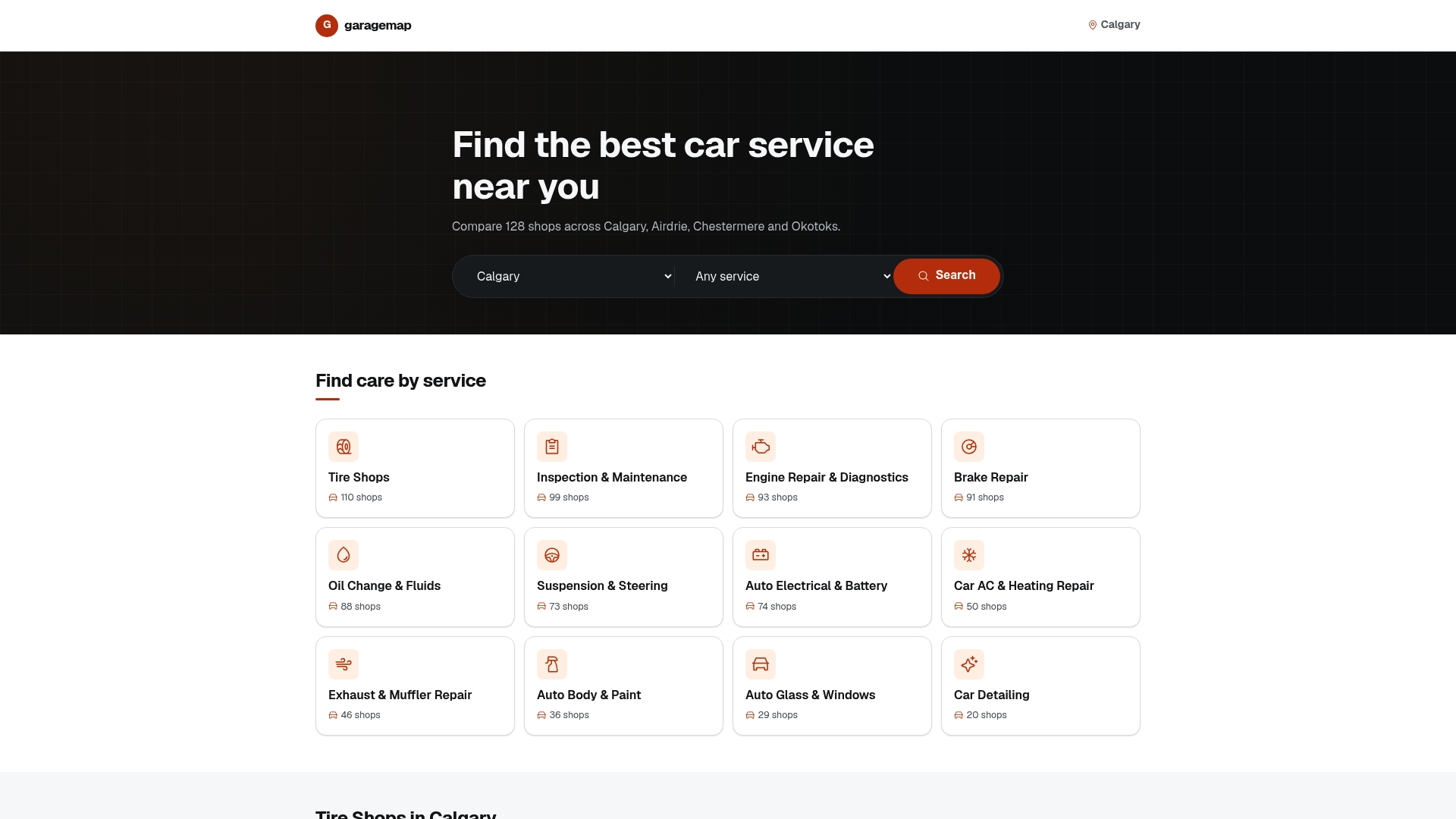
Once DIY checks stop turning up answers, you can compare local shops instead of calling garages one by one. You can describe what you need, such as engine diagnostics, an EVAP smoke test, or wiring work for a communication code, and request quotes directly from shops that offer these services.
-
Search engine repair and diagnostics providers if your code points to a drivability or emissions issue.
-
Try electrical and battery specialists for U-codes or anything tied to wiring, grounds, or module communication.
-
Include your exact code, the freeze frame details if you have them, and recent symptoms when you request a quote, so shops can give you a real estimate instead of a generic one.
Start at Garagemap to compare shops and request quotes based on the codes you've already pulled.
Sources
FAQ
What are some common OBD2 fault codes?
The most frequently seen codes include P0171 and P0174 (system too lean), P0300 (random misfire), P0420 (catalyst efficiency below threshold), and EVAP codes like P0442 and P0455. Each one points to a system, not a specific part, so the code is the starting point for testing rather than the final answer.
What OBD2 scanner can read all codes?
No single consumer scanner reads every code on every vehicle, since coverage depends on the vehicle, its communication protocol, and the scanner's software. Basic readers handle generic P-codes well, while professional-grade tools add manufacturer-specific codes, bi-directional tests, and full module access.
What are the 10 OBD2 modes?
OBD‑II defines a set of diagnostic service modes that scan tools use to request different kinds of data, such as current data, freeze frame data, stored and pending trouble codes, and vehicle information. Exact mode numbering and naming can vary by reference source, so check your scan tool's documentation or vehicle service manual for the specific modes it supports.
What are the most common check engine light codes?
Beyond the lean and misfire codes, P0420/P0430 (catalyst efficiency), P0128 (thermostat regulation), and P0700 (transmission control malfunction) round out the codes drivers see most often. Each has its own set of likely causes, so matching the code to a quick DIY check first can save an unnecessary shop visit.
Should I replace a part based on a code alone?
No. A diagnostic trouble code shows that a specific test failed, not which part caused it, so confirming the root cause with targeted tests first avoids paying for parts that were never the problem.