Follow a simple rhythm: check oil, tires, and lights monthly; let your owner's manual or oil-life alert set your service intervals; rotate tires every several thousand kilometres, typically every 6,000 to 8,000 kilometres; and book milestone services around 30,000, 60,000, and 100,000 kilometres. This guide is practical shorthand. Your manufacturer's schedule always overrides generic advice, especially if you drive under severe conditions.
TL;DR:
- Regularly check oil, tires, and lights monthly to catch minor issues before they become costly repairs or safety hazards.
- Follow manufacturer-recommended service intervals, especially at 30,000, 60,000, and 100,000 km, as these involve critical system inspections and replacements.
- Replace engine oil according to the vehicle's oil-life system rather than the old 3,000-mile rule to avoid unnecessary services and costs.
- Prioritize safety-related maintenance like tire rotations, brake inspections, and light checks if you have limited time for vehicle care.
- Use the owner's manual and maintenance scheduling tools to tailor service intervals based on your driving conditions, especially under severe use.
Table of Contents
- Monthly car maintenance checklist: the 10-minute routine
- What car maintenance is due at 30,000, 60,000, and 100,000 km?
- How often should you change fluids and filters?
- Tire rotation, alignment, and brake wear: what to watch for
- Battery, belts, and hoses: the parts that fail without warning
- Do you need a severe maintenance schedule?
- Getting the most out of your owner's manual and oil-life system
- Practical priorities for busy owners
- Finding a shop for the work this schedule requires
- Where these intervals come from
- Sources
- FAQ
Monthly car maintenance checklist: the 10-minute routine
Most roadside breakdowns trace back to something a driver could have caught in ten minutes. A monthly walk-around catches the cheap problems before they become expensive ones.
- Oil level: Pull the dipstick when the engine's cold, wipe it, reinsert fully, then check the level. Oil below the low mark isn't just a top-up reminder. It can signal a leak or excessive burn that needs a mechanic's eyes.
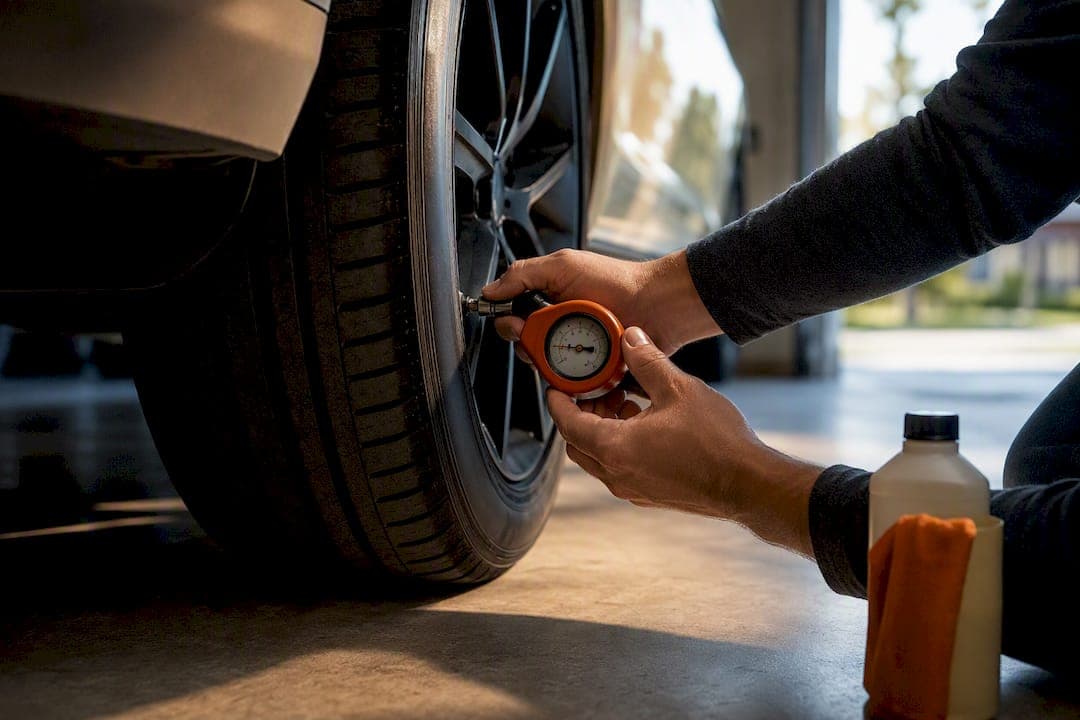
- Tire pressure: Check when tires are cold, using the PSI number on the driver's door jamb sticker, not the number printed on the tire itself. Glance at tread and sidewalls for cracking or bulges while you're down there.
- Lights: Walk around and confirm headlights, brake lights, and turn signals all fire.
- Washer fluid and wipers: Top up fluid and check that wiper blades aren't tearing or skipping.
- Under the car: A quick look for fresh puddles or drips under the engine bay.
Topping off oil or washer fluid is a DIY job. A leak, a warning light, or a tire that's losing air on its own belongs with a shop.
Pro Tip: Keep a small tire-pressure gauge and a basic fluid top-up kit in your trunk. Catching a slow leak on a Tuesday morning beats discovering it on a highway on-ramp.
What car maintenance is due at 30,000, 60,000, and 100,000 km?
Mileage milestones give you a rough map for budgeting and booking ahead, even though your exact vehicle maintenance schedule depends on your specific make and model.
- Every 5,000 to 10,000 km: Oil and filter service as your manual or oil-life system indicates, a tire rotation, and a quick visual brake check. Consumer Reports notes synthetic oil commonly stretches this interval toward the higher end of that range.
- Around 30,000 km: A more thorough inspection. Air and cabin filters usually need replacing by now, brakes get a closer look, and fluids get topped off rather than just eyeballed.
- Around 60,000 km: This is where coolant or transmission service often enters the picture, along with a belt inspection and a battery test. Some manufacturers spec belt replacement by this point.
- 100,000 km and beyond: The big-ticket work lives here. Timing belt replacement where your engine uses one, major fluid services, and a suspension inspection. Kelley Blue Book flags timing belts specifically as work you don't want to push past the upper limit, since failure can take the engine with it.
Fleet-management guidance built around a 30/60/90 milestone framework makes a similar point commercial operators already know: intervals shift with vehicle type and use, not just distance. A delivery van and a weekend sedan hitting the same odometer number don't need identical work.
How often should you change fluids and filters?
Fluids age differently, and each one gives you a different warning sign when it's overdue.
- Engine oil: Follow your manual or oil-life system rather than the old "every 3,000 miles" rule, which predates modern synthetic blends. Expect a service in the Consumer Reports range noted above, with cost scaling based on conventional versus synthetic oil.
- Transmission and differential fluid: Check your manual for the interval; some automatics are "lifetime fill" until a technician's inspection says otherwise.
- Brake fluid: Moisture creeps into brake fluid over time and lowers its boiling point, which is why most manufacturers call for a change every couple of years regardless of mileage.
- Coolant: Replacement windows typically run several years or tens of thousands of kilometres. A sweet smell, a rising temperature gauge, or visible puddles under the front of the car mean don't wait.
- Air and cabin filters: A clogged engine air filter drags down fuel economy; a clogged cabin filter shows up as weak airflow or musty odours from the vents.
Nearly a third of vehicle owners skip a manufacturer-recommended service interval at some point, often because they assume the "check engine" light would tell them if something were actually wrong. It won't, for most fluid-related wear.
Tire rotation, alignment, and brake wear: what to watch for
Tires and brakes are the two systems where "I'll get to it later" turns into a safety problem fastest.
- Rotation: Every 6,000 to 12,000 km, roughly matching your oil-service visits. Uneven wear from skipping rotations shortens tire life and can affect handling in wet or icy conditions.
- Tread depth: The coin test works fine: insert a toonie into the tread groove. If you can see the rim of the coin, it's time to start shopping for new tires.
- Balancing and alignment: A steering wheel vibration at highway speed usually points to a balance issue; a car pulling to one side or wearing tires unevenly on the edges points to alignment.
- Brake pads and rotors: Squealing is your pads telling you they're near the wear limit. Grinding means metal on metal, and that's a same-week appointment, not a someday one. Have pads and rotors visually inspected at every tire rotation.
Battery, belts, and hoses: the parts that fail without warning
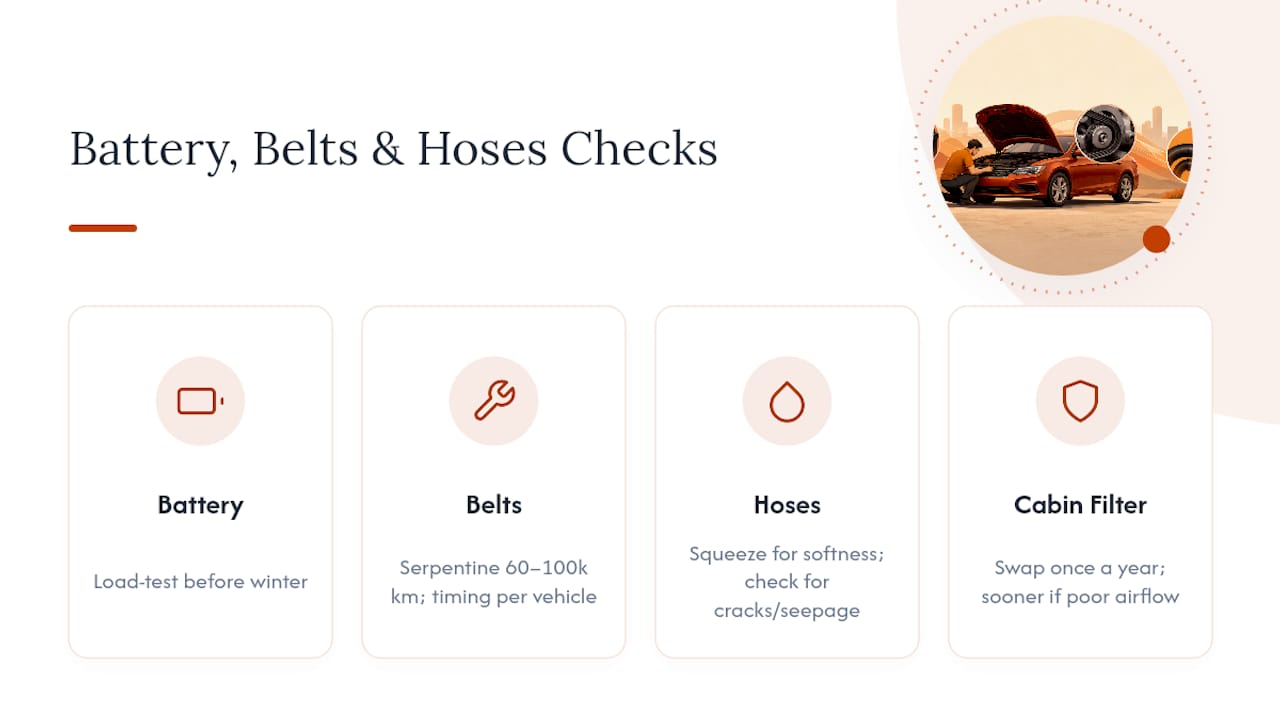
Batteries typically last several years, with lifespan affected by climate and usage, less in extreme cold, and a load test at your yearly service catches a weak one before it leaves you stranded. Have it tested going into winter.
Serpentine belts drive your alternator, power steering, and air conditioning, and most run 60,000 to 100,000 km before replacement; a timing belt, where your engine has one, operates on a stricter interval because it fails without warning. Hoses deserve a squeeze test for softness or swelling and a look for cracking or seepage at the clamps. Cabin air filters usually need swapping once a year or so, sooner if you notice weak airflow or odours from the vents.
Do you need a severe maintenance schedule?
Manufacturer manuals split maintenance into "normal" and "severe" schedules, and most owners actually qualify for severe without realizing it. Severe usage includes frequent short trips, towing, stop-and-go city driving, extreme heat or cold, and regular exposure to salted roads. Any of those shorten your service intervals, sometimes significantly.
- Winter: Test your battery, confirm your coolant mix is rated for the cold, and consider winter tires if you're in a region that sees real snow.
- Summer: Check your A/C performance and keep an eye on tire pressure, since heat causes it to fluctuate more than owners expect.
- Year-round in salt-belt regions: Road salt accelerates rust on brake lines and undercarriage components faster than most owners plan for, and ongoing rinsing and rust protection makes a measurable difference over a vehicle's life.
Pro Tip: If two or more severe-usage conditions apply to how you actually drive, follow the severe schedule in your manual by default rather than guessing case by case.
Getting the most out of your owner's manual and oil-life system
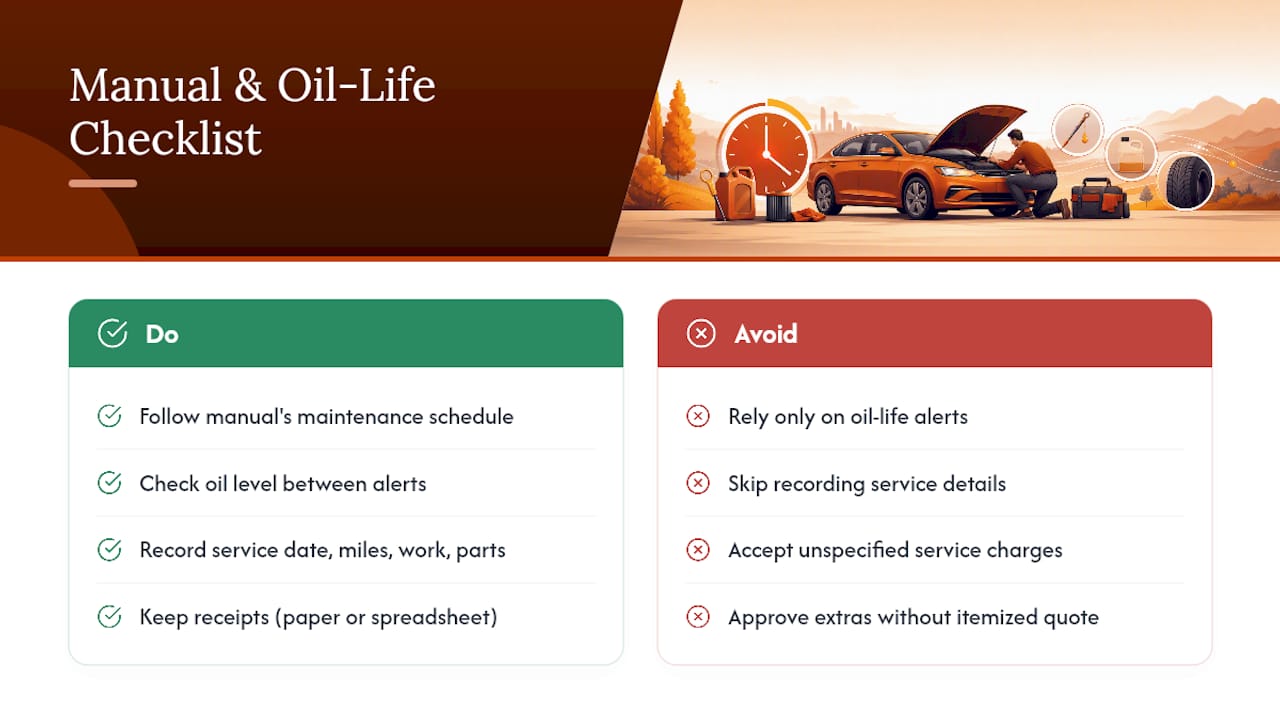
Your owner's manual has a maintenance schedule section, usually organized by mileage or time, and it's the actual authority here, ahead of any generic list including this one. Oil Life Management systems calculate wear based on driving conditions and trigger an alert when service is due, but they assume you're checking the oil level manually between alerts. The system can't warn you about a leak dropping your oil level between scheduled checks.
After every service, record the date, odometer reading, work performed, parts used, and keep the receipt. A simple spreadsheet or a folder of paper receipts both work, and either one protects your warranty claims and adds resale value. Before agreeing to a recommended flush or extra service, ask the technician what inspection result justifies it and request an itemized quote separating parts from labour.
Practical priorities for busy owners
If you only have time for some of this, do the safety-critical work first: tires, brakes, and lights, in that order. Everything else is important but rarely dangerous if it slips a few weeks.
Bundling helps more than people expect. Booking oil, filter, and tire rotation together at one visit saves both trips and, often, shop labour fees. DIY handles the monthly checks fine, but once you're diagnosing a noise, a leak, or a warning light rather than just topping something off, a professional's time is worth the cost. Guessing wrong on brakes or a timing belt costs more than the diagnosis would have.
— Andrii
Finding a shop for the work this schedule requires
There are other ways to find a mechanic: word of mouth, driving past a shop with a sign out front, or calling around and hoping someone has an opening. This platform lets you search and compare vetted shops across Calgary, Airdrie, Chestermere, and Okotoks by the exact service you need, whether that's an oil change, a tire rotation, a brake inspection, or a full diagnostic.
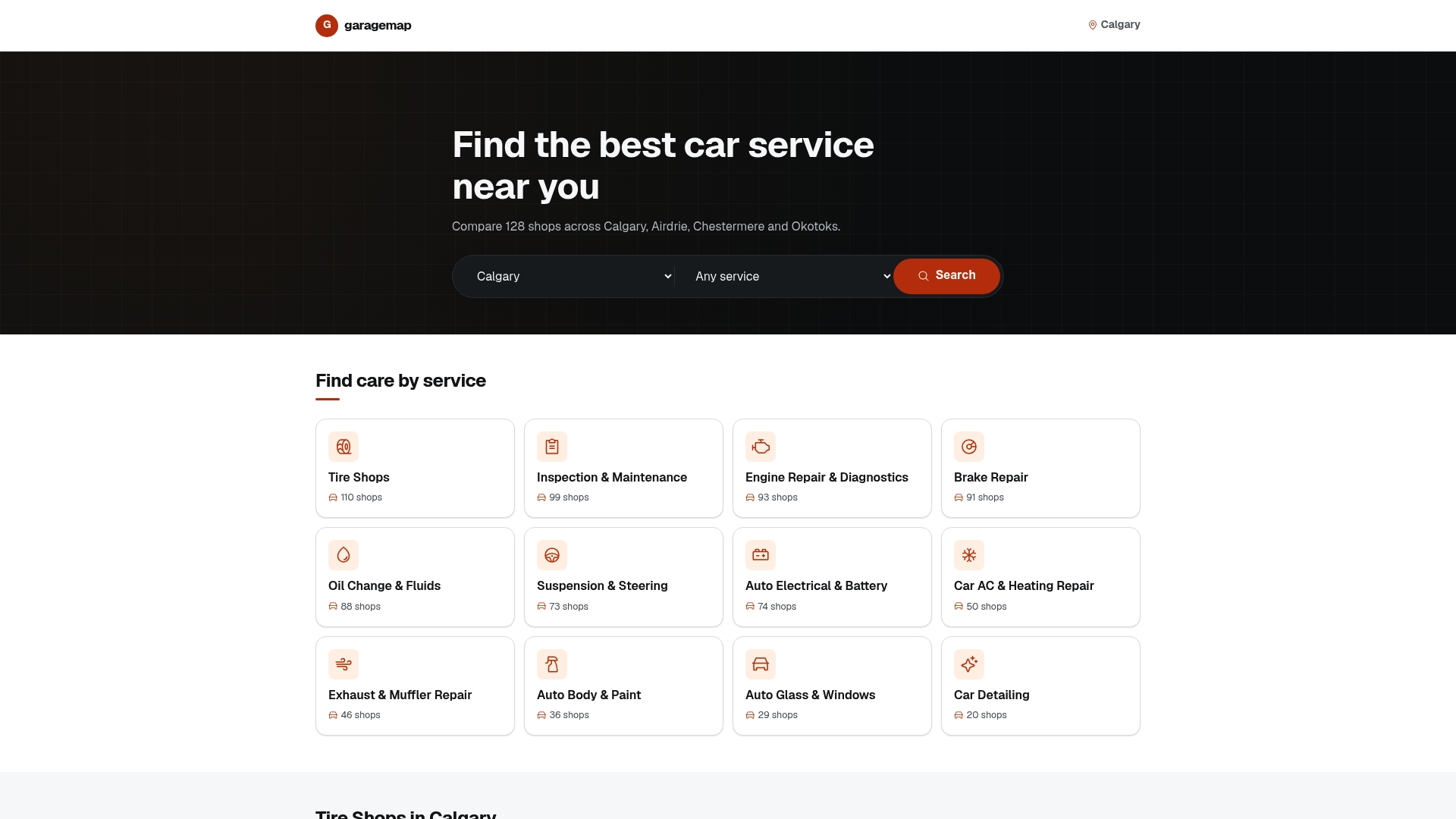
Instead of calling five shops to compare rates for a 60,000 km service, you filter by service type and see your local options side by side. That's the real advantage over cold-calling: less time spent chasing quotes, more time spent actually getting the work done. Whether you're due for routine inspection and maintenance or chasing down a dashboard warning light, start your search on GarageMap's Calgary page and book with a shop that already matches what your car needs.
Where these intervals come from
These ranges draw on Consumer Reports' maintenance guidance, AAA's checklist structure, and manufacturer manuals. Always confirm your vehicle's exact schedule before booking major work.
Sources
- Consumer Reports' guide to car maintenance
- Scheduled maintenance service (manufacturer guidance)
- AAA time-stamped car maintenance checklist
- Geotab glossary: maintenance intervals
FAQ
What is a typical maintenance schedule for a car?
A typical schedule includes monthly checks of oil, tires, and lights; oil and filter service every 5,000 to 10,000 km or per your oil-life alert; tire rotation on the same cycle; and larger inspections at 30,000, 60,000, and 100,000 km.
What car maintenance needs to be done at 50,000 miles?
Around 60,000 km, expect a brake inspection, possible pad replacement, a coolant check, transmission fluid evaluation, and a battery test, alongside your regular oil and filter service.
What car maintenance should be done every six months?
Every six months, rotate your tires if you haven't hit the mileage-based interval yet, inspect belts and hoses for wear, test your battery, and check brake pad thickness.
What is the recommended car maintenance schedule by kilometre?
Follow the 30k/60k/100k framework as a baseline: lighter service and inspections at 30,000 km, moderate work like coolant and belts around 60,000 km, and major items like timing belts and suspension checks by 100,000 km, always adjusted to your manufacturer's actual schedule.