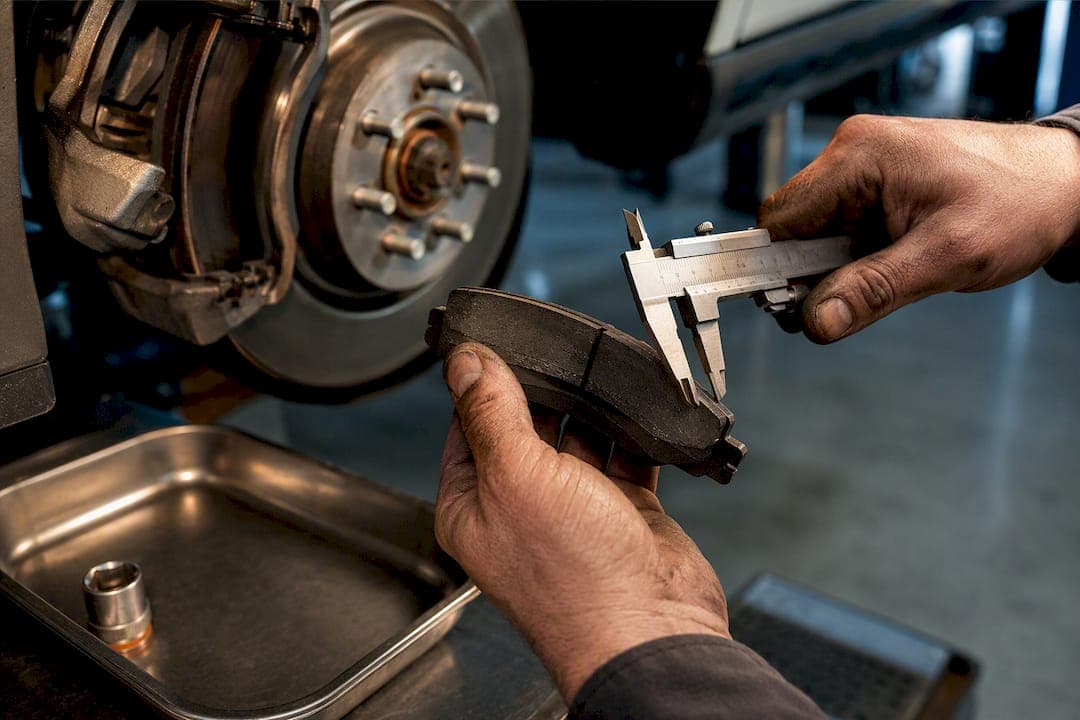
Most brake pads last within a typical range spanning several tens of thousands of miles (roughly tens of thousands of kilometres), though the honest answer is "it depends more on you than on your car." Driving style and conditions decide where you land in that range far more than the pads themselves do. Check them at every regular service, and sooner if you hear noise, feel vibration, or notice longer stopping distances.
TL;DR:
- Brake pads typically last between 25,000 and 70,000 miles, with front pads wearing two to three times faster than rears due to higher braking load.
- Driving style and brake work significantly impact pad lifespan, with aggressive braking and heavy loads decreasing durability regardless of time or mileage.
- Signs of imminent replacement include squealing, grinding noise, vibration, longer stopping distances, or warning lights, especially when pads reach 2 to 3 millimeters in thickness.
- Regular self-checks through caliper inspection and professional servicing every 10,000 to 15,000 km help prevent unexpected failures and optimize pad lifespan.
- Using the correct pad type for your driving conditions, avoiding late braking, and maintaining components can extend pad life and improve braking performance.
Table of Contents
- Brake pad lifespan in miles, kilometres, and years
- What actually determines how fast your pads wear
- Signs your brake pads need replacing now
- How to check remaining pad life yourself
- Simple habits that stretch pad life further
- Why I'd rather you replace early than push your luck
- Get your brakes checked by a vetted local shop
- Sources
Brake pad lifespan in miles, kilometres, and years
The 25,000 to 70,000 mile range holds up across most consumer vehicles, and it lines up with what the RAC's brake maintenance guidance reports for typical UK and North American driving. In kilometres, that's about 40,000 to 112,000 km. Translate that into years and the picture gets more useful:
- A driver covering 15,000 km a year sits around 3 to 7 years per set, front pads included.
- A highway-heavy commuter covering 25,000 km a year can hit the low end of that range in under 2 years.
- A low-mileage weekend driver might stretch a single set past 8 years, though rubber components and hardware can age out before the pad material does.
Front and rear pads rarely wear at the same rate. Front pads typically absorb 60 to 70% of total braking force, so they wear two to three times faster than the rears on most vehicles. That's why a shop might replace your front pads twice before the rears need attention once. If your vehicle has rear disc brakes, expect that gap; if it still runs rear drums, the wear pattern shifts again, and it's worth asking a technician directly rather than guessing.
What actually determines how fast your pads wear
Distance alone is a weak predictor. What matters more is braking work, the actual energy your pads dissipate every time you slow down, and that's shaped by a handful of variables you can mostly control or at least anticipate.
Driving style is the single biggest lever. A driver who brakes late and hard converts far more kinetic energy into heat and friction per stop than one who anticipates traffic and coasts down early, and that difference in braking work directly changes wear rate, sometimes cutting pad life by half or more.
Pad compound matters too. Organic pads wear fastest but run quiet and easy on rotors. Semi-metallic pads split the difference between longevity and stopping power. Ceramic pads typically last the longest and handle heat well, though they cost more upfront.
Vehicle weight and load change the math directly. A truck hauling a trailer or a minivan loaded with cargo needs more braking force per stop, which accelerates wear regardless of compound.
Fact: Front pads carry roughly two to three times the braking load of rear pads on most passenger vehicles, which is why front axle replacement almost always comes first.
Terrain and climate pile on additional stress. Hilly routes and stop-and-go city traffic mean constant braking cycles, while road salt in winter corrodes calipers, slides, and rotor surfaces, sometimes causing uneven wear before the pad material itself is spent. If you drive somewhere that salts heavily, it's worth looking into road salt protection for your vehicle to slow that corrosion down. Hybrids and EVs sit in their own category: regenerative braking does a lot of the slowing at low speeds, so friction pads on these vehicles often last noticeably longer, sometimes double a comparable gas vehicle, because the pads simply do less work.
Signs your brake pads need replacing now
Some symptoms mean "book an appointment this week." Others mean "pull over and call a tow truck." Here's how to tell the difference.
- A high-pitched squeal usually means the built-in wear indicator is scraping the rotor on purpose. It's a warning, not an emergency, but don't ignore it for weeks.
- A grinding or metallic scraping sound means the pad material is gone and metal is touching metal. Stop driving and get it inspected immediately.
- Vibration through the brake pedal or a spongy pedal feel points to uneven wear, a warped rotor, or worn hardware.
- Noticeably longer stopping distances are a performance red flag that outranks any mileage number you've been tracking.
- A dashboard brake warning light on vehicles with electronic wear sensors means the system has already detected the pad is near its limit.
Watch the thickness, too. Most technicians treat roughly 3 mm as a soft warning zone and 2 to 2.5 mm as the hard service limit, the point where you shouldn't put off a replacement. One caveat: a light scraping noise on a cold, damp morning is often just surface rust on the rotor clearing off, which is harmless and different from the grinding of worn-out pads.
How to check remaining pad life yourself
You can get a rough read on pad thickness without pulling a wheel, though it's easier with the wheel off. Look through the caliper opening at the outer pad: if the friction material looks thinner than the metal backing plate behind it, you're getting close.
- Use a flashlight and look straight through the wheel spokes at the caliper.
- Compare the pad thickness to the width of the metal backing plate; roughly equal or thinner means it's time.
- If you can safely remove the wheel, a small ruler or a dedicated pad gauge gives a more accurate mm reading.
To turn a thickness reading into a rough distance estimate, take how many millimetres of pad remain and divide by a per-1,000 km wear rate typical for your driving style. A driver averaging light wear might use roughly 0.1 mm per 1,000 km, meaning 3 mm remaining suggests about 30,000 km left, while an aggressive city driver could burn through that same 3 mm in a fraction of the distance. Treat this as a ballpark, not a countdown clock: researchers using on-road braking data and vehicle dynamics have built remaining useful life models that outperform simple mileage math, but even those carry real error margins because temperature, pad-rotor pairing, and thermo-elastic effects complicate the picture, as a 2025 review of brake pad wear mechanisms lays out in detail.
Pro Tip: Check pad thickness every time your tires are off, whether for rotation or seasonal swap. It costs nothing extra and catches wear before it becomes a warning light.
If you're not comfortable pulling a wheel or reading a gauge, that's exactly the kind of five-minute check worth handing to a professional at your next service.
Simple habits that stretch pad life further
Small changes in how you drive add up faster than most owners expect. Anticipating stops and coasting down instead of braking late reduces the braking work your pads absorb on every single trip. On long descents, using engine braking (downshifting instead of riding the pedal) keeps heat out of the system entirely.
- Anticipate red lights and slow traffic early instead of braking hard at the last second.
- Have calipers and slide pins inspected and lubricated at each brake service to prevent uneven wear.
- Avoid bargain-bin pads that don't match your rotor's original material; mismatched compounds are a common, avoidable cause of premature wear.
- When pads get replaced, have the rotors checked too. A worn or scored rotor paired with fresh pads wears them down abnormally fast.
Pro Tip: If you tow or drive mostly highway, ask for pads rated for heat and load, not just the cheapest set on the shelf. City-only compounds can glaze over under sustained heavy use.
Why I'd rather you replace early than push your luck
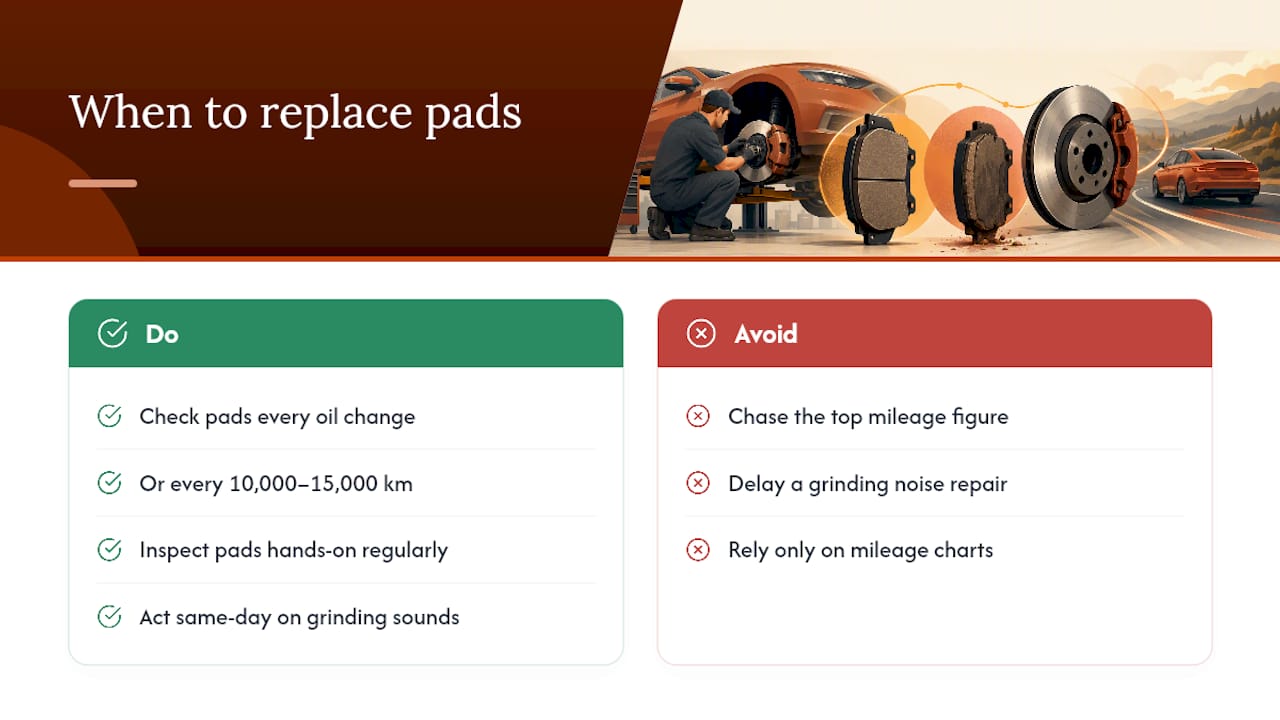
Chasing the top end of the mileage range isn't a badge of honour. Pads are cheap compared to rotors, calipers, or the physics of a longer stopping distance in wet weather. My honest recommendation: check pads at every oil change or every 10,000 to 15,000 km, whichever comes first, and treat any grinding sound as a same-day problem, not a next-week one.
The mileage figures in this guide are genuinely useful for budgeting, but they're averages built from a huge range of driving styles. Your actual number depends on habits more than odometer math, and no chart replaces a hands-on look at the pad itself.
— Andrii
Get your brakes checked by a vetted local shop
Reading about wear indicators is one thing. Getting an actual mechanic to look at your pads is another, and that's where Garagemap earns its keep. Instead of cold-calling shops or guessing which one actually specializes in brake work, you search, filter, and compare vetted providers in one place, so you land on a shop suited to your specific job rather than the first name in a search result.
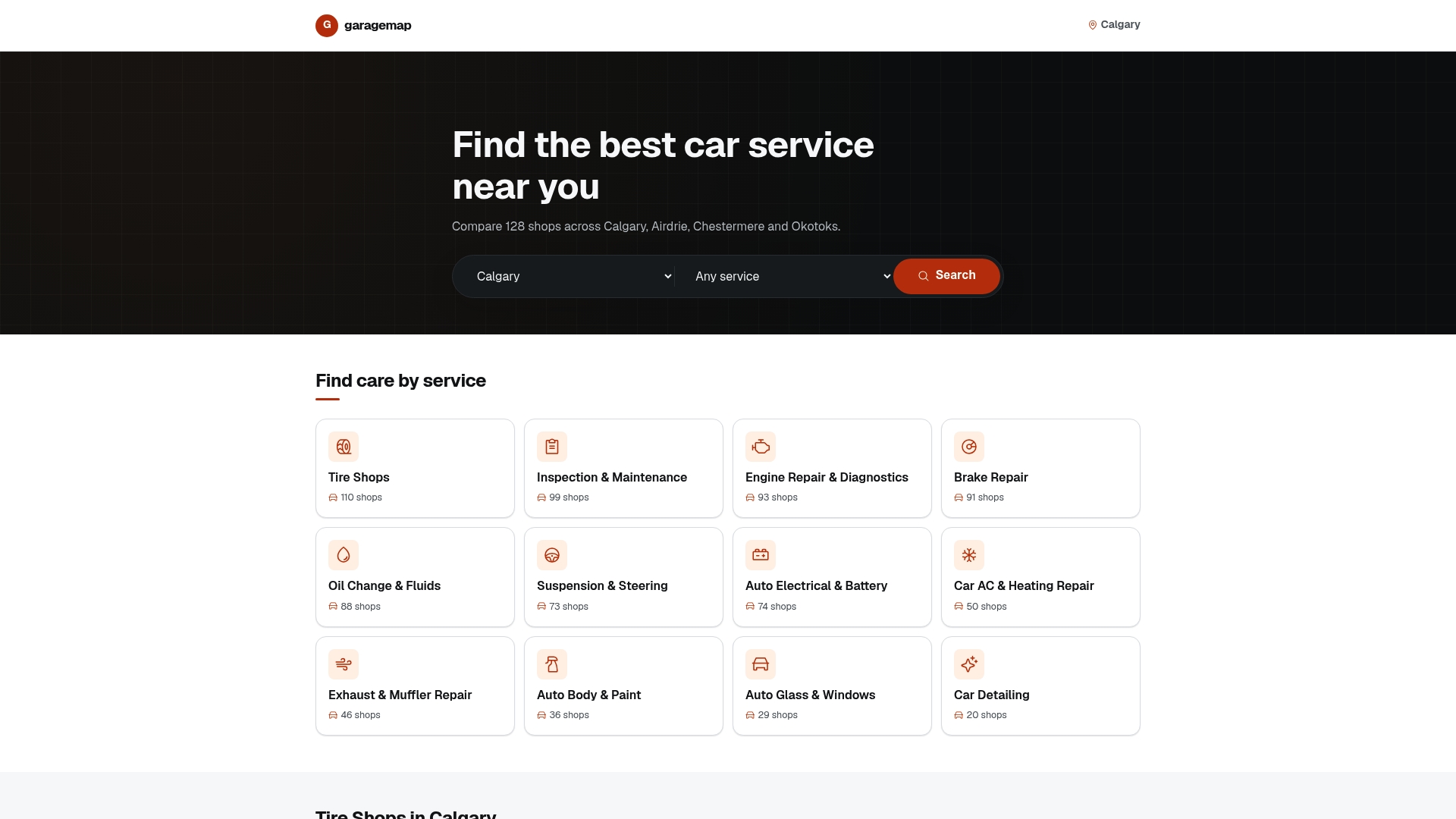
If your pads are near that 3 mm mark, or you've already heard the telltale squeal, Garagemap's brake shop directory lets you compare local options by service type before you commit. Drivers in Calgary can start with the Calgary repair listings directly, filter by brake service, and book an inspection with a shop that fits your schedule and your vehicle.
Sources
The MDPI review on brake pad wear mechanisms and the ScienceDirect study on remaining useful life prediction informed the technical wear estimates. The RAC and Car and Driver supplied the practical replacement thresholds.
- Brake pads and discs - everything you need to know | RAC Drive
- When to replace brake pads — Car and Driver