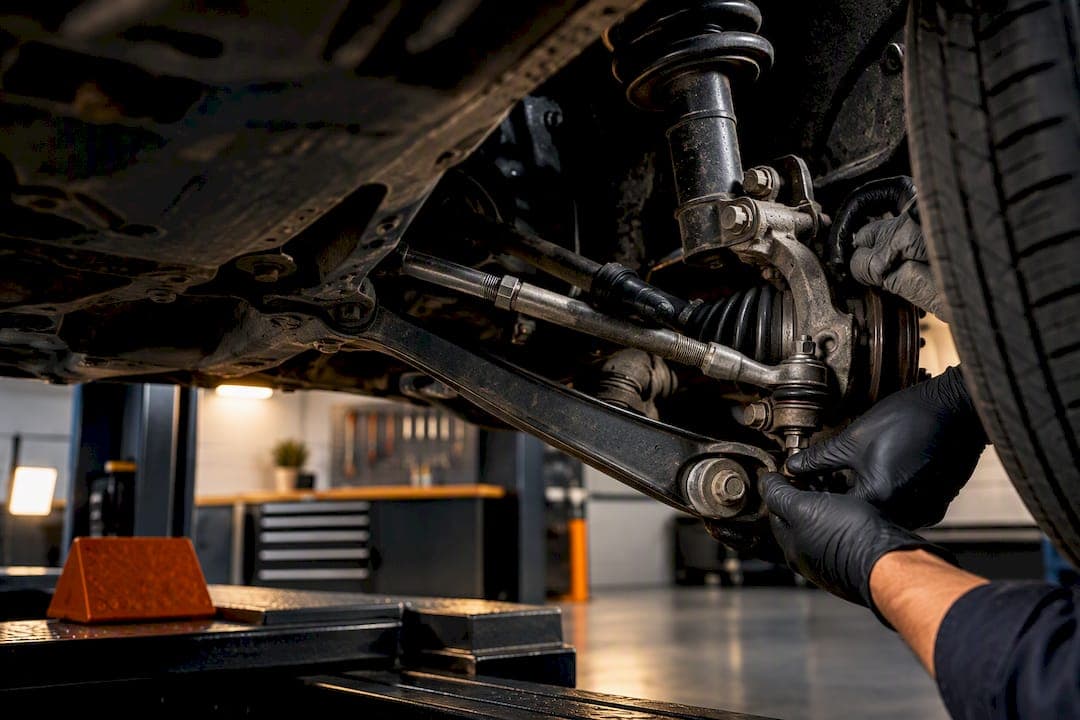
Yes, in most cases. Any repair that touches tie rods, control arms, struts, steering rack, or a subframe changes wheel geometry and calls for an alignment. Standalone shock replacements usually don't. The safest habit: book a professional alignment check as the final step of any suspension job, before you put real mileage on the vehicle.
TL;DR:
- Replacing tie rods, control arms, ball joints, struts, steering racks, or subframes generally requires an immediate professional alignment due to their impact on wheel geometry.
- Standalone shock absorber swaps and sway bar link or bushing replacements usually do not necessitate an alignment unless components were loosened or affected by impact or collision damage.
- After ride-height adjustments with coilovers or lowering springs, a final alignment should be done after the springs settle, typically following a 15-30 km test drive, to avoid uneven tyre wear.
- Skipping or delaying an alignment risks uneven tyre wear, increased mechanical stress, and unpredictable vehicle handling, often resulting in higher long-term repair costs.
- Always inspect for signs like pulling, drifting, or off-centre steering and measure tyre tread for feathering before booking a full four-wheel alignment with documented results.
Table of Contents
- Which suspension repairs always or usually require an alignment after suspension work
- Repairs that usually don't require alignment, and when they do
- When to get the alignment: right away or after a settling period?
- What it actually costs you to skip the alignment
- What happens during a professional alignment appointment
- Can you check alignment yourself before booking a shop?
- How Garagemap helps you find the right shop for the job
- Alignment specs vary by vehicle, not by rule of thumb
- What alignment service actually costs and what drives the price
- Why bad alignment eventually damages more than tyres
- What the checklist mentality gets right, and where drivers still get it wrong
- Where to book your post-repair alignment
- Sources
- FAQ
Which suspension repairs always or usually require an alignment after suspension work
Some parts hold the wheel's position. Others just control how it moves up and down. That distinction decides whether a repair triggers an alignment.
Tie rods set toe angle directly. They connect the steering rack to the steering knuckle, and their length determines how much each front wheel points in or out. Swap a tie rod, even for an identical replacement part, and toe changes because the new part's exact length and thread position won't match the old one's wear pattern. There's no way around measuring and resetting toe after this job.
Control arms and ball joints shape camber and caster, the two angles that determine how the tyre contacts the road and how the steering wheel returns to centre after a turn. A control arm bushing that's slightly stiffer or softer than the original, or a ball joint mounted a few millimetres differently, shifts these angles enough to matter. SAAQ's vehicle modification guidance treats control arm and ball joint replacement as a standard trigger for realignment.
MacPherson struts do double duty: they absorb bumps and they form part of the steering axis. Because the strut mounts to the knuckle and the body, any strut swap can shift camber and caster even when the part is a factory-spec replacement. Shops that skip alignment after strut work are gambling on the new mounting hardware landing in exactly the same spot as the old one, which rarely happens.
Steering racks and subframes affect the entire geometry baseline for the vehicle. A subframe that's reinstalled a few degrees off, or a rack with different internal tolerances, throws off toe and sometimes thrust angle across both axles.
Repairs that almost always require alignment:
- Tie rod or tie rod end replacement
- Control arm or ball joint replacement
- Strut or strut assembly replacement
- Steering rack replacement or major service
- Subframe removal or replacement
- Any ride height change (lift, lowering, coilover installation)
Repairs that usually don't require alignment, and when they do
Not every suspension job disturbs geometry. Knowing the exceptions saves you from paying for alignments you don't need, and from skipping ones you do.
Standalone shock absorber replacement is the clearest example. Shocks damp motion; they don't set the static position of the wheel the way a strut or tie rod does. SAAQ's guidance draws this line explicitly: shocks control ride quality, struts are structural. Swap a shock on a vehicle that uses a separate shock and spring setup (not a MacPherson strut), and geometry typically stays untouched.
Sway bar links and bushings are another low-risk category. These parts control body roll during cornering. They don't influence the static camber, caster, or toe measurements an alignment machine checks.
That said, there are real exceptions worth flagging:
- If the job required loosening strut-to-knuckle bolts, control arm mounting bolts, or any fastener that positions a geometry-critical part, get a check even if the part you replaced wasn't the geometry-critical one.
- If the repair followed a curb strike, pothole impact, or any collision, get an alignment regardless of which specific part failed. Impact damage often bends components in ways that aren't visible.
- If a shop had to jack, pry, or force anything to access the failed part, ask whether alignment-related hardware was disturbed.
When in doubt, ask the shop directly what was loosened during the repair. A five-minute conversation beats guessing.
When to get the alignment: right away or after a settling period?
Get the alignment as the final step of the repair, not weeks later. Driving on misaligned wheels, even for a short stretch, wears rubber unevenly and that damage doesn't reverse. The "wait and see how it feels" approach costs more in tyres than it saves in shop visits.
The one real exception is ride height changes. Coilovers and aftermarket lowering springs need time to seat and settle, and some installers set height slightly higher than the target for this reason, then finish alignment after a short test drive. Springs can settle by roughly 5 to 10 millimetres, which is enough to throw off camber and toe if you align before that settling happens.
Here's a practical sequence for a ride-height install:
- Install the new springs or coilovers and set them to the target height, or slightly above if your installer recommends it for settling.
- Torque every suspension fastener to manufacturer spec, including strut top mounts and control arm bolts.
- Check tyre pressures across all four corners before the drive.
- Drive 15 to 30 kilometres of mixed road, including some rougher pavement, to let springs and bushings seat.
- Return to the shop for the final alignment, including toe, camber, caster, and steering wheel centring.
For everything else, including tie rods, control arms, struts, and steering racks, there is no settling period. Align immediately.
Pro Tip: Only raise ride height above the target for settling purposes if your parts manufacturer or installer specifically recommends it. Guessing at the offset can leave you outside factory tolerance even after the "final" alignment.
What it actually costs you to skip the alignment
Skipping alignment after suspension work isn't a grey area financially. It's a bet against your tyres, and the odds aren't good.
Misaligned wheels wear unevenly in a pattern you can usually see with a close look. Toe misalignment produces feathering, a saw tooth edge you can feel by running a hand across the tread. Camber misalignment wears one shoulder of the tyre faster than the other. SAAQ's guidance notes that even small toe errors cause rapid, visible wear, and that a misaligned vehicle can mask drift or nervous steering that feels like a separate problem entirely.
Watch for these signs after a suspension repair:
- The vehicle pulls to one side on a flat, level road
- The steering wheel isn't centred when driving straight
- Uneven tread wear appears within a few thousand kilometres
- Vibration or wandering at highway speed that wasn't there before
There's a compounding cost too. Misaligned geometry puts extra load on the suspension parts you just paid to replace, along with wheel bearings and CV joints. That's not a one-time expense, it's a slow drain that shows up as repeat shop visits.
The trade-off is straightforward. A four-wheel alignment typically runs a fraction of the cost of a single replacement tyre. Skip it, and uneven wear can force you to replace tyres well before their expected lifespan, turning a modest alignment bill into a much larger one down the road.
What happens during a professional alignment appointment
A proper alignment isn't just plugging numbers into a machine. It starts with an inspection.
Before touching any adjustment, a competent shop checks for play or damage in the steering and suspension. SuspensionHQ notes that adjustments won't hold if a tie rod end is loose or a bushing is worn out, so this step matters as much as the alignment itself. Expect the technician to check:
- Tie rod ends and steering rack play
- Ball joint wear
- Control arm bushing condition
- Tyre condition and inflation
Once the vehicle passes inspection, it goes on an alignment rack, where sensors measure camber, caster, toe, and thrust angle on all four wheels. The technician compares these readings against the manufacturer's spec sheet for that exact make, model, and year.
Not everything is adjustable. Some vehicles have fixed camber and caster with no adjustment mechanism built in, meaning a bent component has to be replaced rather than dialed in. Others offer a narrow adjustment range through eccentric bolts, shims, or cam bolts. A shop should tell you upfront if a component is out of range and can't be corrected without a part swap.
The job wraps with steering wheel centring and, ideally, a documented before-and-after report showing the readings at drop-off and pickup. That printed or digital report is your proof the geometry is back inside spec. Most four-wheel alignments take 45 minutes to an hour.
Can you check alignment yourself before booking a shop?
You can spot warning signs at home. You can't actually measure or correct alignment without the right equipment.
Start with a visual tyre check. Run your hand across each tread face, feeling for that saw tooth feathering pattern that signals toe problems, and look for one shoulder wearing faster than the other, which points to camber issues. Park on level ground and look at the wheels from the front. A wheel that visibly tilts in or out at the top compared to the others is worth flagging.

Check the steering wheel while driving straight on a flat road. If it's off-centre, or if the vehicle drifts to one side without you steering it there, that's a geometry problem, not your imagination.
Here's a short pre-drive checklist that limits damage before you get to a shop:
- Check tyre pressures on all four corners and correct any that are off.
- Look for uneven wear or feathering on each tyre.
- Confirm the steering wheel sits level when driving straight on flat pavement.
- Note any pulling, drifting, or vibration and when it started.
- Avoid highway speeds and long drives until the vehicle's been checked.
Toe is measured in fractions of a degree, and camber tolerances are similarly tight. SAAQ's technical guidance points out that modern vehicles are sensitive enough to small toe errors that professional-grade equipment, not a tape measure or a string line, is the only reliable way to catch and correct the problem.
Pro Tip: If your vehicle pulls hard to one side or the steering wheel is noticeably off-centre after suspension work, don't wait for a "convenient" time. Book the alignment before you drive it regularly, even if that means a shorter first trip to the shop.
How Garagemap helps you find the right shop for the job
Finding a shop that actually does a proper alignment, not a quick five-minute toe tweak, is half the battle. Garagemap's Suspension & Steering search lets you filter specifically for shops that handle both the repair and the post-repair alignment, rather than scrolling through listings for services you don't need.
When you request a quote, be specific: ask for a full four-wheel alignment, not just a two-wheel front check, and ask whether the report includes before-and-after measurements. A shop that hesitates to provide documented numbers is one to skip.
Mention the recent suspension work in your booking request, including which parts were replaced and roughly when. That context helps the shop plan the inspection properly instead of assuming everything's still tight and factory-fresh. If tyre wear is already visible, it's worth checking Garagemap's tire shop listings at the same time, since a shop handling both jobs together can often coordinate the sequence better than two separate appointments.
Alignment specs vary by vehicle, not by rule of thumb
There's no universal number for correct alignment. Every manufacturer publishes its own camber, caster, and toe specifications for each model and trim, usually expressed as a range rather than a single figure.
A typical passenger sedan might call for camber within a fraction of a degree of zero, with a tolerance window of about plus or minus a quarter degree per side. Trucks and SUVs, carrying more weight and often riding higher, tend to run different caster targets to keep steering stable at speed. Performance vehicles sometimes spec negative camber intentionally, for better grip in corners, which would look "wrong" on a family sedan but is correct for that platform.
Thrust angle matters too. It measures whether the rear axle points straight relative to the vehicle's centreline. A rear-wheel-drive vehicle with worn rear suspension bushings can throw off thrust angle even when nobody touched the rear suspension recently.
The only reliable way to know your vehicle's targets is the manufacturer's spec sheet for that exact year and trim, which is what a competent alignment technician pulls up before touching the rack. If a shop can't tell you what your specific numbers should be, or quotes you a generic figure that sounds the same for every car on the lot, that's worth questioning.
What alignment service actually costs and what drives the price
A standard four-wheel alignment is a modest expense compared to the parts and labour that preceded it, though the exact price depends on a few factors.
Vehicle type plays a role. All-wheel-drive vehicles and trucks with more adjustment points typically cost more to align than a basic front-wheel-drive sedan, since there's more to measure and adjust. Vehicles with limited factory adjustment, where a shop needs aftermarket camber bolts or shims to bring angles into spec, also run higher because of the extra parts and labour involved.
Shop equipment matters as much as vehicle type. A shop running a modern 3D alignment rack with digital sensors tends to charge differently than one relying on older equipment, partly because the newer systems catch thrust angle issues and provide the kind of before-and-after report worth having.
Bundling matters too. Many shops offer a discount when alignment is booked alongside the suspension repair itself, since the vehicle is already up on the lift and the technician is already there. Booking the alignment as a separate visit days or weeks later often costs more and risks tyre wear in the meantime.
Ask for a quote that specifies whether it covers two wheels or four, and whether the price includes a printed report. Those two details explain most of the price variation you'll see between shops.
Why bad alignment eventually damages more than tyres
Misalignment doesn't stay contained to tread wear. It spreads stress to everything downstream of the wheel.
A wheel sitting at the wrong camber angle loads the suspension bushings and ball joints unevenly, wearing one side faster than a properly aligned setup would. Wheel bearings take on side loads they weren't designed for when toe is off, which can shorten their service life. CV joints on front-wheel-drive vehicles operate at odd angles when camber and caster fall outside spec, adding wear to a component that's expensive to replace.
There's a safety dimension too. Misalignment changes how a vehicle responds during an emergency lane change or a hard brake on a wet road. A vehicle that pulls or wanders under normal conditions behaves less predictably when you need every bit of grip and control, particularly at highway speed or in poor weather. This is part of why SAAQ's guidance treats alignment as a mandatory step after suspension modifications rather than an optional upgrade.
The practical takeaway: alignment isn't cosmetic maintenance for tyre longevity alone. It protects the mechanical investment you just made in new suspension parts, and it keeps the vehicle's handling behaviour predictable when it matters most.
What the checklist mentality gets right, and where drivers still get it wrong
The biggest mistake I see in how people approach post-repair alignment isn't skipping it outright, it's treating it as optional based on how the car feels. A vehicle can drive perfectly normally while sitting outside manufacturer tolerance, because modern tolerances are narrow enough that your seat-of-the-pants sense simply can't detect a quarter-degree camber error. That's not a minor technicality. It's the entire reason alignment racks exist instead of mechanics eyeballing wheels.
Where conventional advice falls short is the "wait and see" instinct around ride height changes. Waiting for coilovers to settle makes sense. Waiting to book the alignment afterward does not, and too many DIY guides blur that distinction. Settle first, align immediately after, not "align whenever it's convenient."
If you take one thing from this article, prioritize the inspection step before adjustment. A shop that skips checking for worn tie rod ends or loose bushings is setting numbers that won't hold past your next pothole.
— Andrii
Where to book your post-repair alignment
This platform helps you find shops that perform full four-wheel alignments with documented reports. The platform aggregates vetted local shops across Calgary, Airdrie, Chestermere, and Okotoks, letting you filter directly for suspension, steering, and tire services instead of sorting through listings for oil changes and detailing you don't need right now.

Start by searching Suspension & Steering shops in your area, or check tire shop listings if uneven wear is already visible on your tyres. When you request a quote, ask specifically for a full four-wheel alignment with a before-and-after measurement report, and mention what suspension work was just completed so the shop knows what to inspect first. If you're near Calgary, the Calgary car repair listings narrow the search to shops in your immediate area. Compare a couple of quotes, check what each report includes, and book the one that gives you real numbers, not just a verbal "it's fine."
Sources
Quebec's transportation authority publishes detailed technical guidance on vehicle modifications and their alignment implications; the SAAQ vehicle modification guidance covers which suspension changes require realignment and why tolerance for toe and camber errors is so narrow.
For a technical breakdown of which specific suspension parts trigger a mandatory alignment, SuspensionHQ's guide on alignment after suspension part replacement walks through pre-alignment inspection standards that reputable shops follow.
- SAAQ vehicle modification guidance — modify your vehicle
- SuspensionHQ — do you need an alignment after replacing suspension parts?
FAQ
Can bad suspension mess up alignment?
Yes. Worn ball joints, loose tie rod ends, or damaged control arm bushings let wheel geometry drift out of spec even without any recent repair. A shop should inspect these components before attempting alignment, since worn parts prevent adjustments from holding.
How long does it take for a new suspension to settle?
Coilovers and lowering springs typically settle within the first 15 to 30 kilometres of mixed driving, with springs compressing roughly 5 to 10 millimetres from their initial set height. Standard strut and control arm replacements don't need a settling period at all, since they don't compress over time the way a new spring does.
Do you need an alignment after a suspension lift?
Yes, always. A lift changes ride height, which alters camber, caster, and toe across all four corners. SAAQ's guidance treats ride-height modifications as a mandatory trigger for full alignment, including toe setting and caster adjustment.
How long should I wait for alignment after installing coilovers?
Set the coilovers to your target height, drive a short distance of 15 to 30 kilometres to let the springs settle, then book the alignment. Don't wait weeks or drive extensively before that final alignment step, since misaligned wheels wear tyres quickly even over short distances.
Does Garagemap offer alignment services directly?
Garagemap doesn't perform repairs itself. It connects you with vetted local shops offering Suspension & Steering services, including alignment, so you can compare options and request quotes from shops in your area.